Friday, November 6, 2015

The Washington Post, 5 Nov 2035

Mormon Church makes doubting couples apostates, excludes children from blessings and baptism

The Church of Jesus Christ of Latter-day Saints announced a new policy in its handbook stating that children living in an skeptical or inactive family may not be blessed as babies or baptized until they are 18.

The policy change, which also states that those in a semi-active household are to be considered apostates, was confirmed Thursday by church spokesman Orson F. Packer.

"Church handbooks are policy and procedural guides for lay leaders who must administer the church in many varied circumstances throughout the world," Packer said in a statement.  "The church has long been on record as opposing non-Mormon lifestyles.  While it respects the law of the land, and acknowledges the right of others to think and act differently, it does not condone or accept doubt or halfheartedness within its membership."

The LDS Church, popularly known as the Mormon Church, teaches that the Church is an institution created by God to facilitate complete and unquestioning devotion.  Before this week's change, the church's policy was that doubt or inactivity may require discipline.  Now that evidence of the Book of Mormon's fraudulent claims is readily available throughout the internet, the church decided to identify those who lend any credence to anti-Mormon criticism as apostates, or people who have renounced their faith.

Mormon children are normally blessed as infants and entered into the LDS Church records.  Most Mormon children are baptized around age 8, an act that Mormons believe is a covenant with God and essential to salvation.

The new policy says that once natural or adopted children living in a skeptical, scholarly, "New Order Mormon," "cafeteria Mormon," or any otherwise incompletely committed household reach 18, they may disavow the practices of anti-Mormonism, non-Mormonism, and casual Mormonism and stop living within the household.  If the individual follows those two rules, they may request approval to be baptized, confirmed, ordained to the church priesthood and recommended for missionary service with the permission of the faith's highest leaders, the First Presidency.

The LDS Church has been vociferously active on issues related to skepticism, secularism and anti-Mormonism.  Earlier this year, Church Apostle Neil L. Andersen even went so far as to proclaim, "Everything you have ever been told by anyone about Joseph Smith that didn't make him sound like he was the greatest man to ever live other than our Savior was an irresponsible and bald-faced lie hissed forth by the amoral, bitter, and loathsome enemies of God's church."  Later, in the same address, he added, "Give the Book of Abraham a rest."

The church, which has expressed fears that cultural secularism could trump traditional brainwashing, received national backlash after it fought to remove courses covering logic, critical thinking, and analytical research from public universities in California in 2028.  Last month, David A. Bednar, the President of the Church, said that "the more we teach our children to weigh so-called evidence and find their own so-called solutions to modern-day issues, the more we teach them to ignore the tried and true methods of living that have satisfied generations of righteous tithe-payers."

Salt Lake City, where the LDS headquarters are based, just elected Ronald Domitrowicz as the city's first openly anti-Mormon mayor this week.  As religious groups, Jehovah's Witnesses, Scientologists and Mormons are the most opposed to different lifestyles.  About 54 percent of Mormons oppose having non-Mormons in their neighborhoods while 16 percent favor it, according to Pew Research's 2034 Landscape Study.

The changes to the LDS handbook were first published online, but Packer reluctantly sent the same changes to the Washington Post.

[The article this post is based on can be found here.]

Saturday, October 31, 2015

Helaman 6: Corrupting the Ante

This is a confusing time in Book of Mormon history.  The Gadianton Robbers are gaining power and influence, the Nephites are becoming wicked, the Lamanites are becoming righteous, up is down, black is white, dogs and cats living together...mass hysteria.


A Woman's Place is in the Sewing Room
While describing the abundance and prosperity among the Nephites, this chapter makes a point to specifically mention women (verse 13):
Behold their women did toil and spin, and did make all manner of cloth, of fine-twined linen and cloth of every kind, to clothe their nakedness.
But that's it.  That's all they did.  They made clothes.


Nephite Security 
In verse 15, poor old Cezoram, the Chief Judge, is murdered "by an unknown hand" while he's sitting on the actual judgment seat, much in the way Pahoran was murdered.

This is the third assassination of a Chief Judge in less than thirty years.  And let's not forget a very notable close call when Kishkumen tried to kill Helaman.  At what point do the Nephites wise up and get some kind of secret service detail going?  Clearly they won't always have that one random servant around to stab would-be assassins in the heart.


The Power of Secrets
As the Gadianton Robbers grow in power and influence, they develop "secret oaths and covenants," whatever that means.  It sounds like they're halfway between a modern-day cult and a group of dirty Gotham City cops.  But what's interesting is this callback to Alma 37 (verse 25):
Now behold, it is these secret oaths and covenants which Alma commanded his son should not go forth unto the world, lest they should be a means of bringing down the people unto destruction.  
Of course, then the chapter explains (with unnecessary dramatic repetition) that the Gadianton Robbers got these oaths and covenants straight from the devil himself, which makes Alma's words of doom all the more pointless.

It's also worth pointing out that this is insanely paranoid.  Why do oaths and covenants have that kind of power?  How can they be so irresistible to the people that, if made public, everyone would become ensorcelled by their allure and eventually the society would be utterly destroyed?  Alma was so terrified by this possibility that he urged his son to only tell the people what their enemies did, and to teach them to abhor those things...but to never divulge "all their signs and their wonders."  (Alma 37:27)

No.  That's just bad.  And it's something that's reflected by the modern church.

How do today's apostles handle ex-Mormons and anti-Mormons?  By telling the church what these people do and teaching them to abhor those things...but never divulging the why.  Without explaining honest reasons people fight against the church, the context is lost.  All people hear is that ex-Mormons are bad and they do bad things, but without understanding the causes of that behavior, all the church membership is hearing is an interpretation of reality—which is not necessarily truth.

If you don't try to understand your enemy, how can you be sure that your enemy's motives aren't valid?  How can you be sure that you're right and he's wrong?  How can you expect to find truth if you're only getting an interpretation and not hearing any solid fact or opposing testimony?

Tuesday, October 27, 2015

Our Magical Mythical Mother

I'm not exactly an on-the-scene reporter, here, so I'm a few days behind the curve on this.  But the church has recently released two additional gospel topics essays—one about women's standing in the church and the other about our fabled Heavenly Mother.  Women and their arguable lack of equality in Mormonism has been a hotly debated issue lately (Ordain Women, Kate Kelly, et cetera), and the essay about women (which, in my opinion, didn't do much to establish that women are indeed equal in the church beyond trying to insist that they are) has had a lot of attention, so I'm going to focus more on the one entitled Mother in Heaven...especially since I'm pretty sure these new essays are intended to be supplementary to each other.

This unsigned, unattributed article begins by explaining that we are all children of two heavenly parents and that "the doctrine of a Heavenly Mother is a distinctive and cherished belief among Latter-Day Saints."  What cracks me up is that the next thing the essay says is that there was no formal revelation given to Joseph Smith concerning the subject.  Heavenly Mother, it seems, is such a cherished woman that even Joseph Smith, the restorer of the fullness of the gospel in the final dispensation of times, couldn't be bothered to go on the record about her.  And you have to wonder about God, too, and why that guy seems intent on shrouding his wife in mystery instead of letting his children interact with their mother the way they supposedly get to interact with their father.

The essay also mentions the fact that Mormons are taught to pray to God the Father in Jesus's name, with no mention whatsoever of the woman who birthed our spirits and is supposed to have raised us in the premortal existence.  "The fact that we do not pray to our Mother in Heaven," the unnamed ghostwriter explains, "in no way belittles or denigrates her."


I can assure you that if I directed all my communication to my parents through my father and siblings without ever bothering to contact my mother directly, she would feel both belittled and denigrated. I think most mothers would.

Former Apostle Rudger Clawson is quoted as saying "We honor woman when we acknowledge Godhood in her eternal Prototype."  This, to me, is honoring Heavenly Mother (and, by extension, earthly women) for her contribution to our spiritual DNA, perhaps, but it's hardly honoring her as an individual.  I could talk all day long about how I inherited my hair color and my stubbornness from my mother, but if I'm not willing to discuss the things she personally taught me and the specific characteristics I admire about her, how much can I really be said to revere her?  Perhaps I can honor her when I acknowledge my adulthood in her physical prototype.  But that's really all it is.
Something else relevant about Clawson's quote is the apparent context.  I tried to see if I could find a scan or complete transcript of the Millennial Star article from which his quote is lifted, but all I could discover with my limited powers of Google-Fu was a slightly longer excerpt [one place I found it].  Preceding the above quote in the article is this:
It doesn’t take from our worship of the Eternal Father, to adore our Eternal Mother, any more than it diminishes the love we bear our earthly fathers, to include our earthly mothers in our affections.
To be fair, without finding the complete article, I can't say for sure, but it seems to me that the quote in the LDS.org essay was, originally, used in an effort to persuade members of the church that it's okay to love our Heavenly Mother.  If this is indeed the case, I have two problems with this.

First, if the church teaches that Heavenly Mother and Heavenly Father are interdependent equal partners (because the other new essay insists that men and women are), then this kind of thing should have never needed to be said.  How many people wonder if it's okay for them to love their biological mothers?

And second, Clawson's comparison begs a glaring question:  If we should love both our spiritual parents the same way we love both our physical parents, why should we worship one spiritual parent and not the other?  Isn't the whole point that they are equally deserving?

After all those Sunday School discussions about the characteristics of God and after all the scriptural stories of the Father's interactions with his people even down to the specific words that he's spoken, what do we know about our Heavenly Mother?  Not much.  We know that she's God's wife and she is the mother of our spirits.  We don't get to talk to her and she doesn't even get to talk to us.  Hell, we don't even know her name.

I'm failing to understand how this is supposed to make the church look like it sees women in the eternal scope as anything other than wives and spirit mothers.  These essays make a big deal about the interdependence of man and woman—that one cannot get to heaven without the other.  But it seems like, other than that, there isn't much in the way of equality.  Heavenly Father is the Creator, he's the Man With the Plan (of Salvation), he's the one we worship, the one we pray to, the one we read numerous scriptural accounts of, and the one whose name we actually know.

Who is our Heavenly Mother?

To us, she's basically nobody.  A spiritual egg donor.  She exudes no sense of individuality, she provides no interaction and exhibits no characteristics beyond motherhood.  Perhaps Mormons revere her and shroud her in secrecy because of her sacredness, but I don't think it's fair to say that men and women are equal in the Kingdom of God when Heavenly Father runs everything and forces us to be completely estranged from our mother. 

Tuesday, October 6, 2015

Notes on the Sunday Evening Session

We do not strive for conversion to the church, but to Christ and his gospel, a conversion that is facilitated by the church.
D. Todd Christofferson
If only that were true.  How often do members knock on inactive members' doors to make sure they're still converted to the gospel of Christ?  How often do members knock on inactive members' doors to try to convince them to come back to church?  My recollection of quorum presidency meetings and bishops youth councils is that we were always focused on getting them to show up on Sunday mornings.  We never just stopped in to see if they still believed in Jesus and wanted to follow Jesus's teachings.  Never.

That's because the leadership, despite what Christofferson tries to tell us, wants us to be dependent on the church far more than it wants us to be converted to Christ and his gospel.

But together, in the church, the ability to care for the poor and needy is multiplied to meet the broader need and the hope for self-reliance is made reality for very many.
D. Todd Christofferson 
I could use this in response to basically every conference talk.
 Here's what I've seen the church do with the pooled resources of its membership:  It's spent billions of dollars building condominiums, constructing a massive mall, peppering the globe with more than one hundred needlessly ornate temples, buying huge properties, operating ranches and a game preserve, and probably some other expensive stuff that I can't think of.  What does any of that have to do with helping the poor and needy?

Sure, there's the bishop's storehouses, which (if I recall correctly) can supply free food to those on church welfare.  However (if I also recall correctly), it's usually difficult to qualify for church welfare.  The storehouses and welfare opportunities are generally a good thing, but it only helps the needy within the church's own ranks.  The church also frequently responds to natural disasters, sending its members out to help, sometimes dressing them in bright shirts that identify them as Mormons.  And that's generally a good thing, except that the church offers photo-op-ready members and not much in the way of much-needed cash.

If the church really were concerned about helping the poor and needy, the temples would be less extravagant, the City Creek Center wouldn't exist, and the Salt Lake headquarters would be busily shipping AIDS treatments to Africa, setting up soup kitchens and homeless shelters in cities worldwide, sponsoring after-school sports programs for kids in areas with high gang activity, and plenty of other things like that.

I suppose, to be fair, Christofferson only said that the church's ability to help the poor is magnified.  He didn't say anyone was actually gonna do it.

With the keys of the kingdom, the Lord's servants can identify both truth and falsehood and once again authoritatively state, "Thus saith the Lord."
D. Todd Christofferson 
 You know how many different bishops I lied to?  You know how many of them called me on it?  None.  You know how many of the General Authorities who were involved in the purchase of Mark Hoffman's artifacts stepped up to say they were forgeries?  None.  Let's not pretend that the leaders of the church have BS detectors that work any better than the average person's.

And more to the point, when's the last time a General Authority said "thus saith the Lord" when not quoting scripture?  When's the last time one of the Twelve explicitly claimed that a specific subset of his words was the exact will of God?

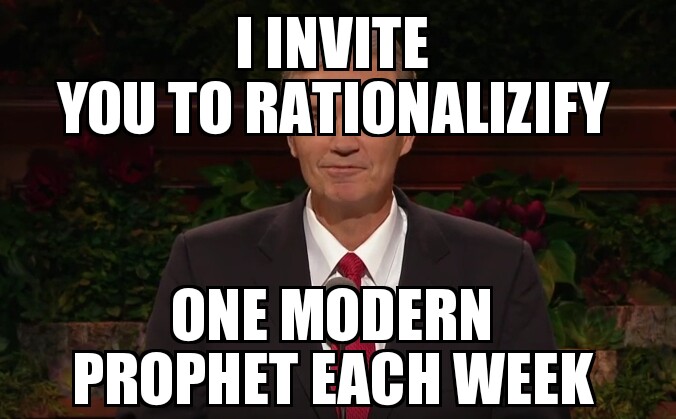
I invite you to "ponderize" one verse of scripture each week.
Devin G. Durrant 
Plenty has already been said about this.  So I'll just skip the criticism of his greatly overused wordplay and just link to an article about his son's attempt to cash in on Durrant's newly propagated catchphrase.

"Don't be too critical of the barrier," he said.  "It's the only thing that's keeping you from being devoured."
 —Von G. Keetch
Yay!  More fear-mongering!

Keetch's speech focused on an experience he had in Australia, which he used to compared a net in the ocean to the ostensible restrictions of the commandments.  The above quote is from a wise old Australian surfer who was reminding the young Americans that even though it seemed like the barrier was totally harshing their mellow, it was actually providing an essential protection from shark attacks.

I'm pretty sick of the closed-minded, one-sided dogma.  I'm not saying the church should tell people it's cool to do whatever, but when the commandments are collectively compared to protection against being devoured, it makes kids grow up thinking that having a glass of iced tea is the spiritual equivalent to diving into a shark tank holding a bucket of chum.  Perhaps the argument could be made that encouraging experimentation is just as irresponsible, but I think that, at the very least, experimentation shouldn't be actively demonized.

When specific rules of varying magnitude aren't explained as being protection against specific consequences of varying severity because every rule is lumped in together as homogeneous protection against homogeneous consequences, it should be clear that it's a matter of control, not safety.  Keetch isn't trying to help people, he's trying to utilize fear to keep them in line.

In this world of increasing fear, distraction, adversity, and anger, we can look to [the Quorum of the Twelve] to see how disciples of Jesus Christ filled with charity look, sound, and react to issues that could be divisive.  They testify of Jesus Christ and respond with charity, the pure love of Jesus Christ, whose witnesses they are. 
Carole M. Stephens
Was Dallin H. Oaks responding with charity when he smacked down the divisive issue of sexism in the church?  Were Christofferson, Marriot, Oaks and Holland responding with charity when they turned a statement about LGBT discrimination into a complaint about religious freedom?   Was Andersen responding with charity when he used a quote in which Neal A. Maxwell compared the church's detractors to Judas?  Was the church leadership responding with charity when they fought tooth and nail against Proposition 8?  Was Brigham Young responding with charity when he taught the blood atonement?  Was he responding with charity when he barred black men from holding the priesthood?  Was Joseph Smith responding with charity when he ordered the destruction of the Nauvoo Expositor?

Isn't your purpose for being on this earth to experience this trial? ...Don't you think that this problem will be resolved when you're resurrected?
 —Koichi Aoyagi, quoting his former mission president
After a car accident in the line of duty (so to speak) left him with chronic pain, young Elder Aoyagi went to his mission president about his problem.  The above is what the guy told him.  This doesn't seem like a particularly useful piece of advice for someone suffering from a condition he hates living with yet can't seem to ameliorate.  Aoyagi came to him for a solution and all he got was a reassurance that he's supposed to be in agonizing physical pain and it will all be taken care of after he lives sixty more years, spends some time in the spirit world, and is eventually resurrected.  What a relief!

While watching this address, I immediately came up with things that I, an apostate without the spirit and without the priesthood stewardship over those missionaries, would have said in that situation.  What amused me was that, later in his talk, Aoyagi mentioned some of the exact things that I came up with—suffering helps us develop empathy, suffering helps us learn how to help others, and although Aoyagi was in a lot of pain, he was lucky to have escaped his car accident with his life.  Sure, none of these things would have solved the problem, but I think they're much more useful than what the supposedly inspired mission president actually said.

Physical restrictions can expand vision, limited stamina can clarify priorities, inability to do many things can direct focus to a few things of greatest importance.  Some people have suggested younger more vigorous leaders are needed in the church to address effectively the serious challenges of our modern world.  But the Lord does not use contemporary philosophies and practices of leadership to accomplish his purposes.  We can expect that the president and other senior leaders of the church will be older and spiritually seasoned men. 
 —David A. Bednar
This whole talk was just slimy.  It was an old guy spending fifteen minutes explaining to his millions of followers why he and people like him were supposed to be in power. But this part in particular was infuriating.

How old was Nephi?  How old were Peter, James, and John?  How old was Alma?  How old was Joseph Smith?  I thought God called imperfect men to accomplish his work, made weak things become strong unto them, and allowed them to exceed their inborn capabilities.  I thought people were given their callings as an opportunity to serve, not to accommodate their talents or wisdom or whatever else.

In a secular organization, older people at the helm might make some sense.  Although age and wisdom do not enjoy a perfect correlation (which I think I've said already within the last few days), generally speaking, more experienced people have had more opportunities to learn.  But the church isn't supposed to be about that.  God calls whom he calls and the capacity for achievement belongs to the office instead of the person who fills it.  This is what I have always heard and always been taught.

If Bednar were being honest, he wouldn't have given credence to the claim that younger leaders would be more capable to address modern challenges. He should have pointed out that anyone called of God at any age is qualified to fulfill his or her calling.  But, of course, if the Quorum of the Twelve really cared about that stuff, they wouldn't have just added three more old dudes to their ranks.


And there you have it.  It's always fascinating to me to see what direction the church is heading in.  I don't know the three new apostles very well, so it will be interesting to see their contributions to the leadership and their takes on the church's current issues.  As with April's broadcast, there was a lot of time devoted to doubt and apostasy.  I found the several references to "if ye are prepared, ye shall not fear" surprising, though.  I was expecting a certain amount of pontificating on things like gay marriage and social media and pornography, but none of those subjects was addressed to the extent that I expected.  Also, Monson looked like he was really struggling during the Sunday morning session, so it's possible we may have a new president of the church by the next General Conference.

I guess we'll see what happens with all of that.

Sunday, October 4, 2015

Mormon-Themed Memes 12: Conference Potpourri

I went a little crazy while I was waiting for the videos and/or transcripts of the last session of General Conference to become available.  So I wound up taking some cheap image-macro shots at some of the general authorities.  My lineup begins with Neil L. Andersen.

First, the direct quote:

And then the fun starts:


Next up is Elder Durrant:


Then we bring out the big bats for M. Russell Ballard:


And then David A. Bednar, is, naturally, our cleanup hitter.  The first pitch is an unspoken corollary to his quotation of Robert D. Hales.


And we'll end with a truly frightening strikeout: