Tuesday, October 6, 2015

Notes on the Sunday Evening Session

We do not strive for conversion to the church, but to Christ and his gospel, a conversion that is facilitated by the church.
—D. Todd Christofferson
If only that were true.  How often do members knock on inactive members' doors to make sure they're still converted to the gospel of Christ?  How often do members knock on inactive members' doors to try to convince them to come back to church?  My recollection of quorum presidency meetings and bishops youth councils is that we were always focused on getting them to show up on Sunday mornings.  We never just stopped in to see if they still believed in Jesus and wanted to follow Jesus's teachings.  Never.

That's because the leadership, despite what Christofferson tries to tell us, wants us to be dependent on the church far more than it wants us to be converted to Christ and his gospel.

But together, in the church, the ability to care for the poor and needy is multiplied to meet the broader need and the hope for self-reliance is made reality for very many.
—D. Todd Christofferson 
I could use this in response to basically every conference talk.
 Here's what I've seen the church do with the pooled resources of its membership:  It's spent billions of dollars building condominiums, constructing a massive mall, peppering the globe with more than one hundred needlessly ornate temples, buying huge properties, operating ranches and a game preserve, and probably some other expensive stuff that I can't think of.  What does any of that have to do with helping the poor and needy?

Sure, there's the bishop's storehouses, which (if I recall correctly) can supply free food to those on church welfare.  However (if I also recall correctly), it's usually difficult to qualify for church welfare.  The storehouses and welfare opportunities are generally a good thing, but it only helps the needy within the church's own ranks.  The church also frequently responds to natural disasters, sending its members out to help, sometimes dressing them in bright shirts that identify them as Mormons.  And that's generally a good thing, except that the church offers photo-op-ready members and not much in the way of much-needed cash.

If the church really were concerned about helping the poor and needy, the temples would be less extravagant, the City Creek Center wouldn't exist, and the Salt Lake headquarters would be busily shipping AIDS treatments to Africa, setting up soup kitchens and homeless shelters in cities worldwide, sponsoring after-school sports programs for kids in areas with high gang activity, and plenty of other things like that.

I suppose, to be fair, Christofferson only said that the church's ability to help the poor is magnified.  He didn't say anyone was actually gonna do it.

With the keys of the kingdom, the Lord's servants can identify both truth and falsehood and once again authoritatively state, "Thus saith the Lord."
—D. Todd Christofferson 
 You know how many different bishops I lied to?  You know how many of them called me on it?  None.  You know how many of the General Authorities who were involved in the purchase of Mark Hoffman's artifacts stepped up to say they were forgeries?  None.  Let's not pretend that the leaders of the church have BS detectors that work any better than the average person's.

And more to the point, when's the last time a General Authority said "thus saith the Lord" when not quoting scripture?  When's the last time one of the Twelve explicitly claimed that a specific subset of his words was the exact will of God?

I invite you to "ponderize" one verse of scripture each week.
—Devin G. Durrant 
Plenty has already been said about this.  So I'll just skip the criticism of his greatly overused wordplay and just link to an article about his son's attempt to cash in on Durrant's newly propagated catchphrase.

"Don't be too critical of the barrier," he said.  "It's the only thing that's keeping you from being devoured."
 —Von G. Keetch
Yay!  More fear-mongering!

Keetch's speech focused on an experience he had in Australia, which he used to compared a net in the ocean to the ostensible restrictions of the commandments.  The above quote is from a wise old Australian surfer who was reminding the young Americans that even though it seemed like the barrier was totally harshing their mellow, it was actually providing an essential protection from shark attacks.

I'm pretty sick of the closed-minded, one-sided dogma.  I'm not saying the church should tell people it's cool to do whatever, but when the commandments are collectively compared to protection against being devoured, it makes kids grow up thinking that having a glass of iced tea is the spiritual equivalent to diving into a shark tank holding a bucket of chum.  Perhaps the argument could be made that encouraging experimentation is just as irresponsible, but I think that, at the very least, experimentation shouldn't be actively demonized.

When specific rules of varying magnitude aren't explained as being protection against specific consequences of varying severity because every rule is lumped in together as homogeneous protection against homogeneous consequences, it should be clear that it's a matter of control, not safety.  Keetch isn't trying to help people, he's trying to utilize fear to keep them in line.

In this world of increasing fear, distraction, adversity, and anger, we can look to [the Quorum of the Twelve] to see how disciples of Jesus Christ filled with charity look, sound, and react to issues that could be divisive.  They testify of Jesus Christ and respond with charity, the pure love of Jesus Christ, whose witnesses they are. 
—Carole M. Stephens
Was Dallin H. Oaks responding with charity when he smacked down the divisive issue of sexism in the church?  Were Christofferson, Marriot, Oaks and Holland responding with charity when they turned a statement about LGBT discrimination into a complaint about religious freedom?   Was Andersen responding with charity when he used a quote in which Neal A. Maxwell compared the church's detractors to Judas?  Was the church leadership responding with charity when they fought tooth and nail against Proposition 8?  Was Brigham Young responding with charity when he taught the blood atonement?  Was he responding with charity when he barred black men from holding the priesthood?  Was Joseph Smith responding with charity when he ordered the destruction of the Nauvoo Expositor?

Isn't your purpose for being on this earth to experience this trial? ...Don't you think that this problem will be resolved when you're resurrected?
 —Koichi Aoyagi, quoting his former mission president
After a car accident in the line of duty (so to speak) left him with chronic pain, young Elder Aoyagi went to his mission president about his problem.  The above is what the guy told him.  This doesn't seem like a particularly useful piece of advice for someone suffering from a condition he hates living with yet can't seem to ameliorate.  Aoyagi came to him for a solution and all he got was a reassurance that he's supposed to be in agonizing physical pain and it will all be taken care of after he lives sixty more years, spends some time in the spirit world, and is eventually resurrected.  What a relief!

While watching this address, I immediately came up with things that I, an apostate without the spirit and without the priesthood stewardship over those missionaries, would have said in that situation.  What amused me was that, later in his talk, Aoyagi mentioned some of the exact things that I came up with—suffering helps us develop empathy, suffering helps us learn how to help others, and although Aoyagi was in a lot of pain, he was lucky to have escaped his car accident with his life.  Sure, none of these things would have solved the problem, but I think they're much more useful than what the supposedly inspired mission president actually said.

Physical restrictions can expand vision, limited stamina can clarify priorities, inability to do many things can direct focus to a few things of greatest importance.  Some people have suggested younger more vigorous leaders are needed in the church to address effectively the serious challenges of our modern world.  But the Lord does not use contemporary philosophies and practices of leadership to accomplish his purposes.  We can expect that the president and other senior leaders of the church will be older and spiritually seasoned men. 
 —David A. Bednar
This whole talk was just slimy.  It was an old guy spending fifteen minutes explaining to his millions of followers why he and people like him were supposed to be in power. But this part in particular was infuriating.

How old was Nephi?  How old were Peter, James, and John?  How old was Alma?  How old was Joseph Smith?  I thought God called imperfect men to accomplish his work, made weak things become strong unto them, and allowed them to exceed their inborn capabilities.  I thought people were given their callings as an opportunity to serve, not to accommodate their talents or wisdom or whatever else.

In a secular organization, older people at the helm might make some sense.  Although age and wisdom do not enjoy a perfect correlation (which I think I've said already within the last few days), generally speaking, more experienced people have had more opportunities to learn.  But the church isn't supposed to be about that.  God calls whom he calls and the capacity for achievement belongs to the office instead of the person who fills it.  This is what I have always heard and always been taught.

If Bednar were being honest, he wouldn't have given credence to the claim that younger leaders would be more capable to address modern challenges. He should have pointed out that anyone called of God at any age is qualified to fulfill his or her calling.  But, of course, if the Quorum of the Twelve really cared about that stuff, they wouldn't have just added three more old dudes to their ranks.


And there you have it.  It's always fascinating to me to see what direction the church is heading in.  I don't know the three new apostles very well, so it will be interesting to see their contributions to the leadership and their takes on the church's current issues.  As with April's broadcast, there was a lot of time devoted to doubt and apostasy.  I found the several references to "if ye are prepared, ye shall not fear" surprising, though.  I was expecting a certain amount of pontificating on things like gay marriage and social media and pornography, but none of those subjects was addressed to the extent that I expected.  Also, Monson looked like he was really struggling during the Sunday morning session, so it's possible we may have a new president of the church by the next General Conference.

I guess we'll see what happens with all of that.

Sunday, October 4, 2015

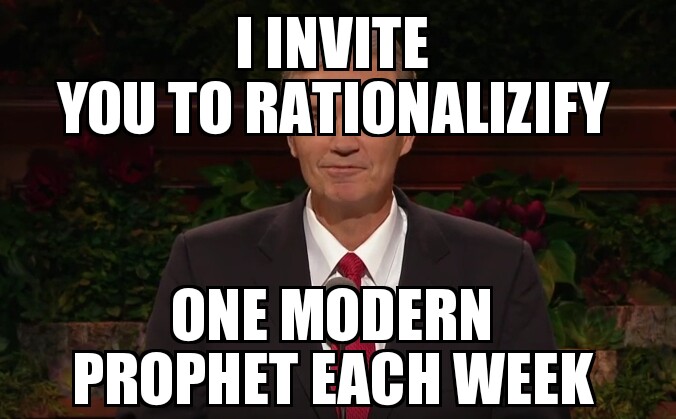
Mormon-Themed Memes 12: Conference Potpourri

I went a little crazy while I was waiting for the videos and/or transcripts of the last session of General Conference to become available.  So I wound up taking some cheap image-macro shots at some of the general authorities.  My lineup begins with Neil L. Andersen.

First, the direct quote:

And then the fun starts:


Next up is Elder Durrant:


Then we bring out the big bats for M. Russell Ballard:


And then David A. Bednar, is, naturally, our cleanup hitter.  The first pitch is an unspoken corollary to his quotation of Robert D. Hales.


And we'll end with a truly frightening strikeout:


Notes on the Sunday Morning Session

Let us speak to others with love and respect, ever keeping our language clean and avoiding words or comments that would wound or offend.
—Thomas S. Monson
He's talking about swearing.  Of all the problems in the world right now, the prophet, seer, revelator and mouthpiece of the Lord has chosen to address the important issue of profanity.

What I think is silly about all this is that the words he's worried about only have offensive power to people who choose to find them offensive.  My coworkers and I, for example, swear at each other constantly, and the only times anyone gets offended is when the context of the profanity indicates that someone is expressing anger or being intentionally disrespectful.  If we're simply joking around or complaining about something, the specific words used aren't that important.  None of us is offended.

Yes, we should speak with love and respect and try to avoid offending people.  But if nobody is being disrespected and nobody finds the f-word offensive, then no harm is being done.  Maybe the prophet should worry about teaching his followers to behave with love and respect instead of merely speaking with love and respect.

I can't remember not believing in Heavenly Father and Jesus Christ.  I have loved them since I learned of them at the knees of my angel mother.
—Ronald A. Rasband
One of our newest inductees into the Quorum of the Twelve is apparently walking evidence that the brainwashing works.  If you've always believed, if you were taught to believe as a child and haven't faltered since, I'm a little dubious of the legitimacy of your faith.  If you can't remember how it started, how can you claim to fully understand its effect on your development?  How can you be sure your personal beliefs are yours instead of someone else's that were embedded in you during your impressionable years?

My dear sisters, you who are our vital associates during this winding-up scene, the day that President Kimball foresaw is today.  You are the women he foresaw.  Your  virtue, light, love, knowledge, courage, character, faith, and righteous lives will draw good women of the world along with their families to the church in unprecedented numbers.
—Russell M. Nelson
Whoa.  What's this, an actual prophecy?  I mean, I guess it's kind of piggybacking off a former president's prophecy, but it still kind of counts.

So when are we going to see this unprecedented spike in membership?  Because it seems to me that the church rolls are transitioning from stagnation to shrinkage.  If there were ever a time that the church could use an adrenaline shot of baptisms, it would be now.  I guess it's time for those women who are so awesome that they deserve a really long list of their awesome qualities to step up and start taking care of business.

The Kingdom of God is not and cannot be complete without women who make sacred covenants and then keep them.  Women who can speak with the power and authority of God.  
—Russell M. Nelson 
The first half of this quote is one of those things that shouldn't need to be said.  I wonder how many women hearing this react along the lines of, "Wait...who was saying the Kingdom of God could be complete without women?  Who is he contradicting?"

The second half of this quote is misleading.  How can women speak with the power and authority of God if they can't hold the priesthood?  

We brethren cannot duplicate your unique influence.  We know that the culminating act of all creation was the creation of woman.  We need your strength.
—Russell M. Nelson 
Nelson lays it on so thick and he doesn't know when to stop.  This talk provides so much meaningless flattery and so many empty blandishments that it becomes more condescending than appreciative.  By implying that women are actually better than men, he relies on a common tactic to reinforce the claim of gender equality in the church.  But, of course, he can claim all he wants that women are the "culminating act of all creation," but if he still praises their ability to advise men, prohibits them from holding the priesthood and severely limits the leadership positions they're eligible to hold, it can hardly be said that women are equal in the church.

Actions speak louder than words and such.

For years, I thought the mocking crowd was making fun of the way the faithful live their lives, but the voices from the building today have changed in their tone and approach.  Those who mock often try to drown out the simple message of the gospel by attacking some aspect of the church's history or offering pointed criticism of a prophet or other leader.  They are also attacking the very heart of our doctrine and the laws of God given since the creation of the earth.
—Gregory A. Schwitzer
Well...he's not exactly wrong, is he?

Personally, I try to mock the beliefs, not the people.  Although I guess I tend to consider public figures, like everybody who speaks at conference, as fair targets.  I hope I've done a good job of avoiding persecution of Mormons and instead focusing on combating the flawed and dangerous religion they follow.  It's the organization and the belief system I despise.  Most of the people in the church are just victims.

But, yes, this means attacking aspects of the church's history.  This means offering pointed criticism of a prophet or other leader.  This means attacking the very heart of the doctrine, which Mormons interpret as being the laws of God.  But the church needs to have a thicker skin.  Instead of crying persecution whenever someone says something it doesn't like, maybe it needs to directly confront the troublesome aspects of its history, its leaders, and its doctrine.

And, no, anonymously posted gospel topics essays on its website and the occasional advice to "give Brother Joseph a break" isn't direct enough.

We live in a time when even the wisest will be hard pressed to distinguish truth from clever deception.
 —Henry B. Eyring
This is also true.  But Eyring is part of the problem by continuing to perpetrate a clever deception on his millions of followers.  My parents and my sisters are smart people.  They're well educated and very capable of critical thought.  But they've had great difficulty distinguishing the truth from the clever deception of the church.  When this much sustained, coordinated effort has been poured into maintaining a fraud, no one of any level of intelligence or wisdom is inherently safe from being fooled.

He shed no tears.  That was because the Holy Ghost had long before given him a clear picture of who she was, where she came from, what she had become, and where she was going.
—Henry B. Eyring 
I don't consider it noble for Eyring's father to shed no tears after witnessing the passing of his wife.  If his faith that she was going to a better place and he would see her again someday was strong enough to help him through that difficult time, then good for him.  But even with his beliefs in the afterlife, he still was not going to be reunited with his wife for a long time.  Eyring's mother died in 1969.  His father didn't pass until 1981.  My girlfriend and I haven't been together nearly as long as Eyring's parents were, but if I wasn't going to be able to see her or talk to her for the next twelve years, it's a safe bet that I'd be shedding a few tears.

You can believe in the afterlife all you want, but don't pretend that the temporary separation of loved ones isn't still tragic.  And what's more, don't imply that all those Mormons who have wept at the deaths of their loved ones have done so because their faith was somehow weak or incomplete.

Notes on the Priesthood Session

Most questions can be resolved through sincere study and seeking answers from God.  Using our mind without our heart will not bring spiritual answers. 
—Neil L. Andersen
Most questions can be resolved?  What are we supposed to do about the ones that can't?   And why is there no warning that using our heart without our mind may not bring logical answers?

For now, give Brother Joseph a break. 
—Neil L. Andersen
You've got to be kidding me.  While this brought a good chuckle from the audience in the Conference Center, to anyone who knows a little about Joseph's life outside what appears in Sunday School manuals, this probably elicited only rage and incredulity.

Give him a break?  Give him a break for marrying other men's wives, using power, threats and promises of postmortal rewards to prey on pubescent girls, publicly lying about his polygamous behavior, evading law enforcement, ordering the destruction of a newspaper that meant to discredit him, and boldly proclaiming that by keeping his church together, he pulled off something even Jesus couldn't manage?

And that's ignoring the creation of a cult-like, bigoted, money-grubbing church.

If you already love Joseph Smith, saying "give him a break" comes off as a good-natured point of amusement.  If you aren't already ensorcelled by the church's favorable narrative of his life, such a comment appears to be reductive, deceitful, and dismissive of actual historical scholarship.

Although heartbroken by the unexpected death of his mother, father, brother and sister, Elder Openshaw's concern immediately turned to his two younger brothers.  Ultimately it was Elder Openshaw and his brother Zane who decided that others could help at home and that Porter should stay on his mission.  They knew it was what their parents would want. 
—Neil L. Andersen
This is, frankly, disgusting.

Four family members just died.  The only one to survive is a little kid.  That kid should be with the immediate family that he has left to help him cope with something unimaginably traumatic.  Porter and Zane both should have gone home immediately to be with their brother and to be united as a family.  There is nothing honorable about putting religious zealotry above the emotional needs of your family in a time of extreme tragedy.  That poor kid probably grew up with his aunt or something, wondering why his big brother wasn't there for him in his time of greatest need.

This is not the kind of example anyone should be glorifying to the entire body of the church.  The church should never be prioritized above family.  There are thousands of other missionaries in the field.  It could not have been so important for Elder Openshaw to stay away from home in such special circumstances when his fellow proselytizers were capable of picking up whatever slack his absence would leave.

My admittedly uneducated guess is that Elder Openshaw may have opted to stay on his mission because losing himself in the work helped him avoid confronting the strong emotions brought on by this tragedy.  Andersen is promoting what could be very psychologically dangerous.

And who cares if it's what the parents would want?  If that's seriously what they wanted (which seems unlikely), they were bad parents.  Maybe the best way to honor their memory would be to come together as a family and stay strong amid adversity and cling tightly to the siblings and relatives that remain.

Seriously.  This story made me so angry.  We don't need more people to do stuff like this.  We need more people who are willing to drop everything and rush home to take care of each other.

He wants to speak to you.  However, it requires a little scientific curiosity.  It requires an experiment upon the word of God and the exercise of a particle of faith.
—Dieter F. Uchtdorf
Don't pretend there's anything scientific about it.  Where are the measurable observations?  Where is the ability to recreate the results in a different lab?  What about another important part of scientific advancement—figuring out your hypothesis is wrong and adjusting accordingly?

I don't know this young man's heart, but I couldn't help but feel terribly sorry for him.  How easily he rejected the gifts the Lord was offering him.
—Dieter F. Uchtdorf
"I don't know this young man's heart, but I apparently know his state of mind well enough to pass judgment on his decision."

Maybe this kid's transition into skepticism and atheism was easy.  But the fact that Uchdorf thinks he can claim it was makes it seem like he's implying that all of us who have rejected the gospel have done so easily.  If that's the case, he's severely missed the mark.

If we can put the burden of proof on God, we think we can excuse ourselves from taking God's commandments seriously. 
 —Dieter F. Uchtdorf
We don't have to put the burden of proof on God.  It's already there.  If he's asking us to believe in him, he should probably give us some reasons to think he's legit.  The person making an assertion is responsible for providing evidence of his assertion.

And this is also a sideways reference to the "he left because he wanted to sin" assumption.  I didn't leave so that I didn't have to take the commandments seriously.  I left because I found far more reasons to think the church was a hoax than to think it was true.  Not having to follow the commandments anymore was an added bonus, I suppose.  But it took me a long time to start breaking any commandments that I wasn't already breaking before my faith crisis started.

Skepticism is easy.  Anyone can do it.  It is the faithful life that requires moral strength, dedication and courage. 
 —Dieter F. Uchtdorf
 I thought Uchtdorf was better than this.

Skepticism is not easy.  Being intellectually honest with yourself and challenging your own beliefs and assumptions takes courage.

But beyond that, I'm appalled by how easily Uchtdorf dismisses the opposition.  Both sides of the aisle have plenty of courage and plenty of cowardice, but membership in neither camp requires either attribute.  The way he writes off skeptics as amoral, weak, and lazy is...well, it's kind of amoral, weak, and lazy.

Saturday, October 3, 2015

Notes on the Saturday Evening Session

If you choose not to take a drink of alcohol, you'll never become an alcoholic.  If you never choose to go into debt, you'll avoid the possibility of bankruptcy.
—Robert D. Hales
What a weird thing to say.  Why would anyone implicitly compare alcoholism and financial debt?  How does Hales expect the majority of his church's members to purchase homes and cars?  Hinckley was always counseling people to get out of debt, which is obviously a great idea.  But Hales seems to think that it's unnecessary in the first place, which is completely baffling.  I would greatly prefer to stay out of debt, but I don't have twenty grand in cash sitting around for the next time I need a new car.

If you want more than you now have, reach up, not across. 
—Robert D. Hales
Hales is trying to make the point that we should look to our parents and elders for advice instead of to our peers.  Unfortunately, not everyone who's experienced has learned from it.  Age and wisdom are not a perfect correlation.  And sometimes the older generation can't provide the advice you need for a problem that may not have existed in such prevalence in earlier times.  It makes a lot of sense to reach across to those who currently have the same struggles to see what they've learned from their relevant experiences.  Really, the last thing we should be doing is closing off avenues for assistance.  We should be reaching up, across, down, and diagonally, maximizing our exposure to ideas and advice.  That way we'll be equipped with as much information as possible so that we can make our choices.

However painful it will be to stand before God, I cannot bear the thought of standing before my mother.  The gospel and her children meant everything to her. I have broken her heart, and that is breaking mine.
 —Jeffrey R. Holland
Holland is quoting a dying apostate whose biggest regret is breaking his mother's heart by abandoning the church.  I can relate.

Unfortunately, that's not a good enough reason to believe in the church.  Ultimately, we have to live our own lives, make our own choices, and behave according to our own consciences.  I deeply regret the worry and the hurt that I have caused my own mother, but honestly, I think the fact that mothers can be so heartbroken when their children leave speaks volumes against the church.  Shouldn't our mothers care, more than anything else, that we're happy and that we're decent people who sincerely try to do the right thing?  Shouldn't those qualities be a cause for joy?  Shouldn't the specific belief system the child adheres to be secondary to all of that?

The church has too strong a hold over the minds of its members. My mother should be disappointed, perhaps.  Disappointed the way a mother might be when her son decides to flip burgers for a living instead of going to medical school.  But not heartbroken.

Besides, I tried forcing myself to believe for the sake of my parents.  I tried pretending to believe for the sake of my parents.  It was grueling.  It was awful.  It's certainly not fair to expect people to live the rest of their lives like that for fear of offending their mothers.

It's to the children of the church I'd like to speak today.  Brothers and sisters, we are engaged in a battle with the world.
 —Bradley D. Foster
Is it any wonder Mormon youth can turn out so weird?

The very first thing this guy does after announcing he's talking to the children is introduce a war metaphor.  Kids perk their ears up because finally somebody on the screen is speaking directly to them and what do they hear?  They hear themselves being pitted against everyone outside of the church.  The world has such an evil connotation to it when you're growing up in Mormonism.

While it's true that tenets of the LDS faith are coming under increasing fire in the public forum, that does not excuse forcing an upbringing of spiritual Spartanism on children.  It does not excuse preparing them to be constantly at odds with their environment, locked in an endless struggle for moral victory.

When I drove home that night, I asked myself:  What kind of father will Pablo be?  And the answer was crystal clear:  He'll be just like his dad.  Jesus said, "the son can do nothing of himself but what he seeth the father do."  This is the pattern for how Heavenly Father blesses His children from generation to generation.
 —Bradley D. Foster
Clearly that statement of Jesus's wasn't intended to be extrapolated across the whole of human behavior.  Obviously not every father is the same kind of father that his father was.  And this pattern of identical parenting that Foster has deliriously fabricated isn't only used to bless people.  Has anyone ever heard the phrase "cycle of abuse?"  And, of course, when that cycle is broken, that contradicts Foster's claim that sons are just like their fathers.

When we consider thoughtfully, why would we listen to the faceless cynical voices of those in the great and spacious buildings of our time and ignore the pleas of those who genuinely love us?
 —Vern P. Stanfill
Nobody should believe that loving a person and knowing what's best for him are the same thing.  Also, no one should assume that when someone leaves the church, he's merely "listened" to faceless, cynical voices.  I prayed, I pondered, I read a lot of stuff, most of it church material, some of it not.  But when I stopped attending, it was a decision that I made.  There was no one who led me out, no pied piper I followed blindly.  There wasn't even one particularly negative piece that made me do it—I made a choice.  Stanfill's assumption that people who leave do so because they're lured by unknown cynics perpetuates a misconception and does everyone on both sides of the issue a huge disservice.

Is it wise to place our eternal well-being in the hands of strangers?  Is it wise to claim enlightenment from those who have no light to give or who may have private agendas hidden from us?
 —Vern P. Stanfill
This is some flimsy reasoning.  How many members of the church actually know the leadership personally?  My family never missed General Conference when I was a kid, but Gordon B. Hinckley was still basically a stranger to us.  All we knew about him was what he said in his prepared speeches and his professionally edited Ensign articles.  Why should we place our eternal well-being in his hands?  How are we supposed to know whether someone has any light to give us before we listen to what they have to say?  Why are we to assume that the Quorum of the Twelve don't have ulterior motives we don't know about?  Is it wise to claim prophecy from those who make no prophetic statements or who may have private agendas hidden from us?

And this also continues the misconception from Stanfill's last quote.  Who said anything about placing our eternal well-being in someone else's hands?  It's about getting as much information as possible and making a decision based on what you can determine from it.  But the decision is in the hands of the individual, not in the hands of any whispering cynics.

God does answer our prayers about the truthfulness of the gospel, but he answers them when we have a sincere heart, with real intent.  He does not answer just to respond to our curiosity.
—James B. Martino
Screw you, Martino, I had a sincere heart and I had real intent when I prayed about the Book of Mormon.  Don't reduce one of the most painful struggles of my life to mere curiosity.

It may not come as quickly or in the format you desire, but the answer will come.  Do not give up.  Never give up. 
—James B. Martino
So...when am I supposed to make my choices, then?  When do I decide what beliefs to base my life and my behavior on?  Does he seriously expect people to go their whole lives being faithful Mormons, all the while still patiently waiting for God to answer a single, simple prayer?

Giving up makes sense.  If you've satisfied the requirements stated in the scriptures and prayed about it time and time again, at a certain point, you should stop.  If the church isn't true, there are probably some other things you want to be doing with your life.  If you spend all your time going to church and praying for a witness of the Book of Mormon, you'll never get to do those things.  Why waste your life being loyal to a god who either doesn't exist or refuses to fulfill his promise to speak to you when you ask one basic question?


Work without faith is dead. 
—James B. Martino
Oh.  That's clever.

He's trying to make the point that in order to receive answers to our prayers, we need to have faith and do good works (which contradicts Moroni 10:4).  But I'm mostly worried that because he's taken a famous scriptural quote and flipped it around all pithy-like, this will be plastered all over social media until the context is forgotten and people are going to think it means that doing good things is meaningless without the gospel.

Who can be succored and strengthened through the atonement of Jesus Christ? 
 —Dallin H. Oaks
This last one amuses me because of the homophone.  As the Apostle Phineas T. Barnum famously asked, "Who can be suckered by the atonement of Jesus Christ?"

Was that a little Freudian slip, Oaks?