Thursday, September 24, 2015

Helaman 4. Things Fall Apart Again

War continues in true Book of Mormon fashion.


That's Some Great Diagnostic Work
After Nephite dissenters swell the ranks of the Lamanite armies, the Nephites are driven out of much of their territory.  Under the leadership of Moronihah, they manage to regain about half, but this chapter has a few things to say about why they lost it in the first place (verses 11-13):
  • their wickedness and abomination
  • the pride of their hearts
  • exceeding riches
  • oppression of the poor
  • withholding food from the hungry and clothing from the naked
  • smiting their brethren
  • mocking that which is sacred
  • denying the spirit of prophecy and revelation
  • murdering
  • plundering
  • lying
  • stealing
  • adultery
  • contention
  • defecting to the Lamanites
  • boasting in their own strength
So there you have it.  It's that simple.  The Nephites are killed and driven out of their homes basically for every reason ever.  Of course, that still doesn't explain why the Lamanites, who are supposed to be guilty of most of this stuff on a regular basis, are made the instrument of the Nephites' destruction instead of being visited with destruction themselves.  Sure sucks to be God's favorites, I guess.


With God Almost All Things Are Possible
Though the Nephites manage to retake some of what the Lamanites conquered, they give up once they've hit the halfway point.  Verse 19 explains why:
Therefore they did abandon their design to obtain the remainder of their lands, for so numerous were the Lamanites that it became impossible for the Nephites to obtain more power over them; therefore Moronihah did employ all his armies in maintaining those parts which he had taken.
Because it was impossible!  Isn't one of the bigger lessons of these war chapters supposed to be that "with God all things are possible"?  Isn't that why the stories of the Stripling Warriors and Captain Moroni victorious against superior numbers and long odds are supposed to be so inspiring?  The Nephites repented of their iniquities four verses ago and they're led by a righteous man, so what's stopping God from giving them the ability to defeat their wicked enemies?

I guess it doesn't serve the plot this time.  Tough break for Moronihah and company.


A Timeline of a Fickle People
In the previous chapter, a "continual peace" was established in the 49th year of the reign of the judges.

In this chapter, it's all gone to hell a mere eight years later.  And even before actual war breaks out, dissention and contention are rampant in Nephite society by the 54th year of the reign of the judges.  That's only five years.  That's hardly continual.  (Although it's hardly the first time I've made this point.)

But even disregarding the poor word choice, these events reek of improbability. Yet again the Book of Mormon peoples are depicted as behaving as a fickle hive mind.  When's the last time a whole population did a moral one-eighty in less than a decade?  These people went from righteous and prosperous to wicked and homeless fast enough to give the whole civilization whiplash.  Even now, as some bemoan the backward slide of modern America into godlessness and amorality, it happens slowly and with great resistance from large portions of the population.  Roe v. Wade and Obergefell v. Hodges are separated by forty-two years.  People pointing to the corruption of American society can't reasonably claim that such a phenomenon isn't gradual and fiercely contested.

Yet the Nephites' moral waffling is repeatedly shown to be swift and unanimous.  But that's just not how large groups of people work.

Sunday, September 13, 2015

A Little Research Goes a Long Way

I usually try to avoid partisan politics on this blog, so please bear with me for a minute...I swear that the following politically-charged rant does tie into my usual musings on Mormonism.

One of my Facebook friends is an older lady I worked with several years ago.  A while after we stopped working together, she found me on Facebook.  Fast forward a few years, and she's basically my best source of maddeningly absurd, frothing-at-the-mouth, right-wing, liberal-hating news.  Every morning she goes online, reads a bunch of awful websites, and then shares a dozen of her favorite links to Facebook.  I don't put much stock in this stuff, but when I come across a headline that makes a particularly shocking claim, I usually follow the link just to make sure it's full of crap.  If some of this stuff is true, I'd definitely want to know about it.

Here's an excellent example from earlier this week:

Immigration continues to be a hotly contested issue in the USA, and if this article was accurate, I felt that I should allow the information contained therein to play a part in shaping my opinion on the subject.  So what the hell.  I clicked on it.

Sweet Jesus.

Rife with bad writing, poor punctuation and baseless accusations, this article has about as much journalistic integrity as the Weekly World News.  Anyone reading it should be able to figure out that it's not a reliable news outlet.  At least...you'd hope so.

Discrediting this story took me about thirty seconds.  I googled Raul Portillo, which was the name the article provided for this illegal immigrant (whose membership in the National Guard is implicitly blamed on Obama) who aided the drug cartels.  There wasn't much, but I found a DOJ statement about it and a far more reputable news item.  And here's what I learned:
  • Portillo was a member of the Arizona Army National Guard long before Obama was elected
  • The crimes in question were committed between 2002 and 2004...during Bush's presidency
  • Nothing indicates that Portillo was an illegal immigrant
  • The photo of the soldier with the eyes covered as though to protect his identity is almost certainly not of anyone named Raul Portillo
There apparently was a guy by that name in the Arizona National Guard who did a lot of shady stuff to help out Mexican drug cartels, but basically nothing else about the article—most notably who was at fault and what the implied time frame was—is true at all.

What I found extremely disheartening was the comment section on Facebook.  It was full of people who hadn't seemed to notice any of the red flags and hadn't bothered to spend those thirty seconds googling:


Apparently, this 75% bogus article is further evidence that the Obama administration has gotten away with too much, that Obama himself is the Antichrist, that he's an idiot, that he's guilty of treason, that he's a liar and a piece of crap and (this last one is possibly my favorite) he was only elected because too many people voted along racial or partisan lines.

Except that Obama has basically nothing to do with this.

That seems fair.

I guess it's a reminder that too many people see what they want to see.  We like to have our deepest convictions confirmed.  We interpret new information in a way that will fuel our preexisting passions.

Personally, I'm terrified of being like that.  I don't ever want to be so sure that everything I believe is correct that I can't be objective about something.  I don't like Mormonism, but I don't want to be so blinded by my anger that I can't admit when the church accomplishes something good and so stubborn in my hatred that I'm willing to believe any slanderous statements against the church without first doing a little rational thinking and a little research.  I don't want to be like these Facebook commenters in any context—political, religious, or even when discussing who's the best character from Firefly.  

This is the laziest kind of bias.  It's confirmation bias on steriods.  It's the easiest way to lie to yourself.  I hope that next time I'm guilty of it, I can catch myself and put a stop to it.

Can't we all be a little more objective?  Don't we owe it to ourselves and to the world to look at as many sides of an issue as we can and to subject our own closely-held beliefs to scrutiny before we speak, before we act, and before we vote?

Monday, September 7, 2015

Oh, FairMormon...Never Change

Because of some crazy masochistic compulsion, I decided to spend a little time browsing FairMormon's website.

Mistake.

I wasted way too much time perusing their rebuttals to the CES Letter.  While plenty of their points are reasonable, too many of them are annoyingly obtuse.  For example, in the section addressing the problematic presence of chariots in the Book of Mormon, Fair's response makes this statement:  "Conspicuously absent is any role of the chariot in the many journeys recorded in the Book of Mormon."  But if you scroll up about half an inch, you'll see that, in the summary of every mention of chariots, in Alma 20, a "Lamanite king uses horses and chariot for visit to neighboring kingdom."  That's not a journey in which chariots were used to transport either goods or passengers?  And even if chariots aren't connected with travelling in the Book of Mormon, that doesn't address the central issue, which is that chariots (and draft animals to pull them) did not exist in America during Book of Mormon times.

Surely it's this kind of flawless reasoning and impeccable scholarship that give FAIR its reputation for integrity.


The argument against anachronistic references to steel is mind-blowing in its ability to ignore the crux of the issue:
Jeremy Runnells says that ancient America didn't have steel and Fair says he's made a mistake because...wait for it...places that weren't America had steel at around the same time.  This, of course, still ignores the central problem that, even if Old Worlders were making steel, there's still zero evidence that it was available to the civilizations depicted in the Book of Mormon.  And zero evidence seems like a pretty big deal considering the millions of Jaredites who killed each other with their steel swords.


But when it comes to addressing the Limited Geography model, Fair outdoes itself:

So when Mr. Runnells discusses where the events of the Book of Mormon might have taken place, what does Fair do?  They zero in on what they apparently perceive as an offensive verb tense and throw multiple detailed resources at us only to make the point that the Limited Geography Model is not a new concept.

First of all, Runnells used the present progressive tense, which doesn't necessarily mean that he thinks the Limited Geography Model is new.  It just means he considers it to be currently developing, which is completely true.

Secondly, Fair does nothing to address the final sentence of Runnells's quote:  "This is in direct contradiction to what Joseph Smith and other prophets have taught."  Remember that time Joseph Smith came across some bones in Illinois and declared them to be from a Lamanite warrior named Zelph?  This is the kind of thing Runnells was talking about.  So while Fair zeroes in on the wording and proclaims Runnells to be disseminating false information, the Zelph thing goes totally unaddressed.


The biggest problem with FAIR's rebuttals is that a lot of them rely on compartmentalizing the arguments.  For example, when Runnells suggests that the direct quotes from the Bible in the independently translated Book of Mormon constitute evidence that Joseph Smith was copying from one book of scripture to create a new one, FAIR says that none of the scribes ever mentioned him having a KJV Bible during the translation process and scoffs at the possibility of memorization.  But when the presence of the italicized words from the KJV in corresponding sections of 2nd Nephi and 3rd Nephi, FAIR claims that whether Smith consulted a Bible "isn't really relevant."  These arguments are reasonable on their own but don't jive with each other.

When FAIR swats down the statement that sheep, though mentioned in the Book of Mormon, were not native to the Americas by providing the example of Bighorn Sheep, they seem to contradict another one of their arguments.  In a different section, FAIR uses a quote from Daniel Peterson to support the Limited Geography Model, but the problem is that Bighorn Sheep only live in the mountainous regions of western North America.  Each argument is reasonable on its own but they don't jive with each other.  If the Limited Geography Model is correct, there should not have been sheep in the Book of Mormon.  If there were sheep in the Book of Mormon, the Limited Geography Model is unlikely.

Compartmentalizing the arguments is kind of missing the point of the CES Letter.  The CES Letter's strength is the sheer tonnage of individual problems coming at the reader all at the same time.  As church members, we tend to notice these things one at a time.  It's easier to dismiss problems or take things we don't understand on faith when we're presented with them in small doses.  But the CES Letter brings so many contradictions and errors to light simultaneously that it becomes much harder to brush them off.  I'm badly paraphrasing Runnells when I say that not any individual argument in the CES Letter should be the nail in the coffin for anyone's testimony, but collectively they can crush the illusions.  When FAIR goes through and tries to argue against it line by line, they've demonstrated a remarkable ability to miss the point on a broad, conceptual level.

Sunday, August 30, 2015

Helaman 3: Logistical Issues

After all this war and chaos and civil unrest and political upheaval, things were just peachy for the Nephites for the next few years.  But only three.  Because if enough bad stuff isn't happening to these guys that we can't glean some kind of twisted spiritual morality lesson from all this, then what's the point of the Book of Mormon in the first place, right?


The Timelines Don't Match Up
Apparently, following these three years of "continual peace," a lot of the Nephites had some kind of unspecified beef with the other Nephites and it was serious enough that one group decided to get the hell out of Dodge (by which I of course mean Zarahemla) and move north.  What a surprise.  Another schism.  Color me shocked.

What I find interesting is that, when these adventurers hit an area that sounds suspiciously like the Great Lakes region and get settled, there are some problems with wood shortages (verses 5 and 6):
Yea, and even they did spread forth into all parts of the land, into whatever parts it had not been rendered desolate and without timber, because of the many inhabitants who had before inherited the land.
And now no part of the land was desolate, save it were for timber; but because of the greatness of the destruction of the people who had before inhabited the land it was called desolate. 
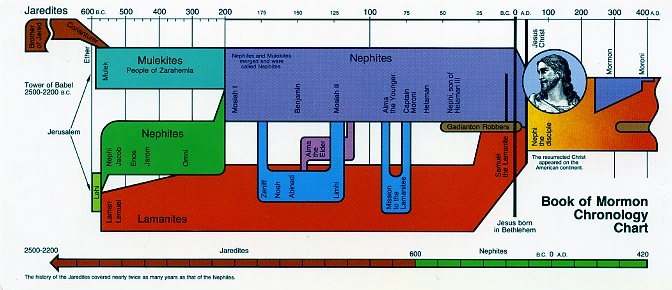
This is a weird passage.  It seems to me that it's talking about the Jaredites, considering the Jaredites numbered in the millions ("many inhabitants"), would have needed a lot of building materials ("without timber"), no longer lived there ("before inhabited the land"), and wiped themselves out in a truly epic fashion ("greatness of the destruction of the people").  But thanks to this church-produced reference card that I and countless others were given in Seminary class, it seems safe to say that, at this point in the narrative, it's been a few hundred years since the Jaredites were kicking it in the land northward.

I'd say five centuries is plenty of time for some of the trees to grow back.  So either this isn't talking about the Jaredites and there was some other massive, hungrily deforesting civilization running around ancient America that God didn't think it was important to discuss or maybe somebody made all these stories up and failed to keep the chronologies straight.


Pre-Columbian Logging, Manufacturing and Trucking
Sadly lacking in the timber department, the locals got smart and started building their towns out of cement.  And in verse 9, they decided to stop cutting down any trees they did find so that eventually a forest would pop up and they'd be able to build with wood again.  Although I'm not sure what they're holding their breath for, because if five hundred years isn't enough time, their great-grandchildren might still be putting up cement huts.  But for those extra special times when they really needed a good old-fashioned wooden edifice, here's what they did (verses 10 and 11):
And it came to pass as timber was exceedingly scarce in the land northward, they did send forth much by the way of shipping.
And thus they did enable the people in the land northward that they might build many cities, both of wood and of cement. 
I'd like to know how a lucrative shipping industry sprang up among the Nephites without much in the way of wheels or domesticated pack animals.  The quantities of timber this chapter is describing would be, you know, kinda heavy.  And therefore very difficult to transport over great distances.

My theory here is that Joseph Smith may have misjudged how much a civilization who wasn't finishing up a huge industrial revolution would be able to accomplish.  Getting a metric buttload of raw materials across the country isn't that big of a deal in the modern age and there were certainly ways of getting it done in the early nineteenth century, but that kind of thing would have been a monumental group effort in the late BC days.

Unless they used boats.  In which case, it's still a matter of overwhelming quantity, because as far as I know there isn't much evidence to support the existence of ancient Native American ships large enough to haul an amount of building materials sufficient to make a single trip worthwhile.


Thus We May See Jack Squat
Verse 27 begins a bizarre riff:
Thus we may see that the Lord is merciful unto all who will, in the sincerity of their hearts, call upon his holy name.
Okay, first of all, no.  God is not merciful unto all who sincerely call upon his name.  I haven't let you forget about all the righteous people in Ammonihah who God allowed to be roasted alive for some idiotically flimsy reason, have I?

And secondly, we do not thusly see any of this, because the preceding verses were talking about how tons and tons of Nephites were getting baptized lately.  No evidence of God's mercy was shown.  This verse could have said "thus we may see that laughter causes lung cancer" and it would have made exactly the same amount of sense.
Yea, thus we see that the gate of heaven is open unto all, even to those who will believe on the name of Jesus Christ, who is the Son of God.
This reminds me of a former employee of mine.  When you ask him if he accomplished a task, he will tell you that it's completely finished.  If you ask him in more detail, he will explain the one or two things he didn't finish until it becomes apparent that he's finished less than half of it.  Why lie when you know you're going to have to immediately amend your statement?

See the similarities between that guy and the above verse?  The gate of heaven is open to everybody!  Well...everybody who believes in Jesus Christ.  And honestly there's a little bit more to it than that, but in a nutshell, that's basically how it works...most of the time, anyway.

Why claim it's open to everybody when it really isn't?  Now the Book of Mormon just looks dishonest and we can't trust it to do its job anymore.
Yea, we see that whosoever will may lay hold upon the word of God...And land their souls, yea, their immortal souls, at the right hand of God in the kingdom of heaven....
Yeah, you weren't talking about that either.  You haven't told any stories recently that support your conclusion.  You were just talking about how so many people were getting baptized.  That was it.

Okay, there was that vague offhand line about "blessings," but that's not even close to being the same subject as sitting at the right hand of God in the kingdom of heaven.

Thursday, August 27, 2015

Helaman 2: The Rise of Gadianton

Although the Lamanite threat is seemingly neutralized for the time being, the Nephites now face some internal problems in the form of Kishkumen and his new friend, the infamous Gadianton


How Does This Plan Work?
Gadianton's namesake, the Gadianton Robbers, are basically a pre-Columbian mafia gang illuminati terrorist organization.  In this chapter, their first big move since becoming associated with the name Gadianton is to murder Helaman Junior because he's recently been elected to the position of chief judge.

Kishkumen is given the impression that, if he commits this murder, he will be given Helaman's job.  I have no idea why anybody thinks that this is a realistic possibility.  Kishkumen's already murdered one chief judge, and all that happened was another election.  Why is there any reason to think that things will happen differently the second time around?  And why is there any chance that Kishkumen will be elected and/or installed as chief judge?

So basically none of this makes any sense.  As usual.


We Don't Need No Stinkin' Laws
Verse 6 begins a little story about a servant of Helaman who has previously disguised himself and infiltrated Gadianton's band. This verse uses the word "as" to imply that something else was taking place while Kishkumen was sneaking in to carry out the murder, but gets so caught up in explaining, mid-sentence, the backstory of this servant of Helaman that it never gets around to specifying the second of the two concurrent events.

But worse than this book's grasp of narrative fluidity and proper grammar is the servant's actions.  Instead of alerting the guards that there was a plot to kill Helaman prior to the assassin's entrance into the building and instead of telling Helaman to flee the judgment seat and instead of calling the guards while Kishkumen was already inside and instead of doing any number of other smarter, safer, and more practical things, this servant takes it upon himself to use the secret methods of communications he's learned from his infiltration efforts to give Kishkumen a false sense of security before stabbing him in the heart.

What.

So much for the rule of law and due process and all of that bullhockey.  While I realize that this servant was trying to accomplish something good by saving the leader of his people, he still murdered someone.  There were plenty of other ways for him to try to save Helaman that wouldn't involve him taking the law into his own hands or stabbing anyone in the heart.

What's even more shocking is Helaman's reaction.  When his servant bursts in and explains all the awful, illegal and violent stuff he just did, Helaman immediately sends his troops out to catch Gadianton and his cronies "that they might be executed according to the law."  No mention of what Helaman decided to do with his servant.

If sending a bunch of guys out to capture Gadianton's Robbers was an option, why didn't the servant tell Helaman about this sooner, while he was sneaking into the group and learning their plans and their secrets?  So much of his behavior is completely unacceptable.  Why is there no discussion of the servant's execution?  Surely if a group of people who conspired to murder someone are presumed guilty on the word of one man and sentenced to execution, then a man who confesses to committing murder himself should have a similar fate.


God is a Bad Editor
The last two verses of the chapter make me chuckle:
And behold, in the end of this book ye shall see that this Gadianton did prove the overthrow, yea, almost the entire destruction of the people of Nephi.
Behold I do not mean the end of the book of Helaman, but I mean the end of the book of Nephi, from which I have taken all the account which I have written. 
That reaaaaally sounds like someone dictated it on the fly.  If those prophets were really that inspired as they were writing all this down and if Joseph Smith were really that inspired when he translated it, you'd think this could have been dropped neatly into one sentence without the instant correction.  Instead of "this book" it could have just read "the book of Nephi."  Problem solved.  14th verse unnecessary.

Unless someone was making this up as he went along, of course.