Introduction
Too often, an ideological chasm
can develop between members of the Church of Jesus Christ of Latter-day Saints
and their friends and loved ones who doubt some aspects of the gospel or who no longer believe in the Church at all.
The Church
has, in the past, tended to steer
its members away
from material that could be damaging to testimonies, instead emphasizing only
Church-approved sources
of information
while describing doubters and apostates in terms that can be considered trivializing
or denigrating. Perhaps as a consequence of the Church's
approach, many faithful believers experience almost visceral reactions to
doubt, criticism, unorthodoxy, and apostasy.
They can be deeply reluctant to wade into any of the anti-Mormon
material they’ve been warned against.
Although I no longer believe in
the Church, I do strongly believe that it is not my place to try and affect or destroy the faith of another
person. I remember what it was like to be a fully invested believer, and I
recall how offensive it was to hear outsiders mock a faith I held so dear and
to see people trying to discredit doctrines I cherished. But I also remember
what it was like to have what I now realize were misconceptions about what some
critics were actually trying to say about my religion. A difference in
religious beliefs should not be the barrier to healthy friendships and familial
relationships that it can frequently become. In the interests of helping people
understand each other and helping to destigmatize doubt, I’ve prepared a list
of items that I hope members of the Church will be willing to consider—not so
that anyone can show them the supposed errors of their religious
traditions, but so members can see that, for better or worse, the critics,
skeptics, and apostates do have some valid concerns. Yes, some might leave the
Church because they’re offended, because they find the lifestyle too demanding,
or because they don’t want to feel guilt for their sins any longer. But more
often than not, the impetus for disaffection from the Church of Jesus Christ of
Latter-day Saints is far deeper, far more nuanced, and far more complex than
something that can be packaged into the clichés we’ve all heard.
I have endeavored to phrase these
questions in a way that is non-argumentative and open-ended. Clearly, I’ve made
my own determinations about the answers to these questions, but I don’t wish
them to be presented in such a way that implies that my conclusions are the only conclusions.
Nothing is accomplished by asking something so blunt and so disrespectful as—if
you’ll pardon the example—“Why is God so racist?” Faithful Latter-day Saints
will not even accept the premise of the question. It doesn’t help anyone
understand another person’s views on the Church's history with racial issues. A
better approach is to ask what explanations we have for the Church policy that formerly restricted people of color from certain ordinances.
As much as possible, I have also
tried to provide publicly available internet links, so that readers can see
what I’m basing my questions on. I first tried to find direct Church sources
for each issue, such as the official website and the Joseph Smith Papers
Project. It’s not reasonable, of course, to expect the Church to provide a
public statement for every little confusing concept or every little troubling
apostolic comment, so when an official source was not available, I searched
for Church-friendly sources, such as BYU scholarship, FAIR Mormon, and the
Deseret News. In a pinch, I have fallen back on more neutral sources, such as The Salt Lake Tribune, The New York
Times, and Wikipedia—although I’ve tried to keep the Wikipedia links
limited, as that obviously does not carry the same weight as long-standing
national news media outlets. You will find no links to MormonThink or ex-Mormon
discussion boards here (although I suppose there are some links to unfriendly
YouTube channels in some cases where videos of Church leaders are cited). There were
many items that, although I felt they raised important questions, did not make
the cut because I couldn’t find a reliable enough source free of blatant
anti-Mormon angles.
The purpose of this is, again, not to influence any member to abandon a
testimony. The purpose is to demonstrate that there are numerous legitimate
concerns that inactives and apostates may have. It is to show that even though
there may be acceptable answers to these issues, there are not simple, obvious
explanations for everything. My goal in this is to help both members and
ex-members alike narrow that ideological chasm. As you read, I’m sure you’ll
find items that you can answer right away. I’m sure there are items that you
know there’s an explanation for, but you’d have to do some digging to find it.
But my hope is that, for most questions, an open-minded reader may be able to say,
“Well, that’s something that I think I can reconcile, but I can see why it
bothers some people so much.”
When a friend or loved one
expresses doubt or experiences a loss of faith, it can damage
relationships—sometimes irreparably. Everyone should feel entitled to maintain
their own convictions, and divergent religious paths should not have to
threaten the stability or the happiness of a family unit. The Latter-day Saint
movement draws upon a rich history and detailed theology, which can be both a
source of wonder for the faithful and a source of consternation for the
skeptics. This is merely an attempt to uncover complexities in the
doctrines and histories, to dispel misconceptions about the concepts that spur
people to leave the Church, and to help families see a middle ground in which
they can understand each other, even as they continue to hold different beliefs.
With these objectives in mind, here
are 220 questions that I hope all Latter-day Saints with doubting loved ones
will be willing to ponder.
Joseph Smith
1. Why does the 1832 account of the First Vision, written
in Joseph Smith’s own hand, detail a different motive for his prayer, a
different number of appearing personages, a different pronouncement from the
heavenly visitor, and a different year of occurrence than the 1838 account
canonized in Joseph
Smith—History?
2. Why did some early Church leaders seem to teach a
version of the First Vision in which Joseph Smith was visited merely by an
angel instead of by God or Jesus? [Brigham
Young, 1855; Wilford
Woodruff, 1855; George
Albert Smith, 1863; John
Taylor, 1879]
3. Can a plausible theory that Joseph Smith
personally crafted the stories of the Book of Mormon be supported by his
mother’s claim that, prior to the coming forth of the Book of Mormon, he
would occasionally give “amusing recitals” about “the ancient inhabitants of
this continent…their mode of warfare, as also their religious worship…with much
ease”?
4. Why does so much Church-produced visual media
(films, paintings,
etc.)
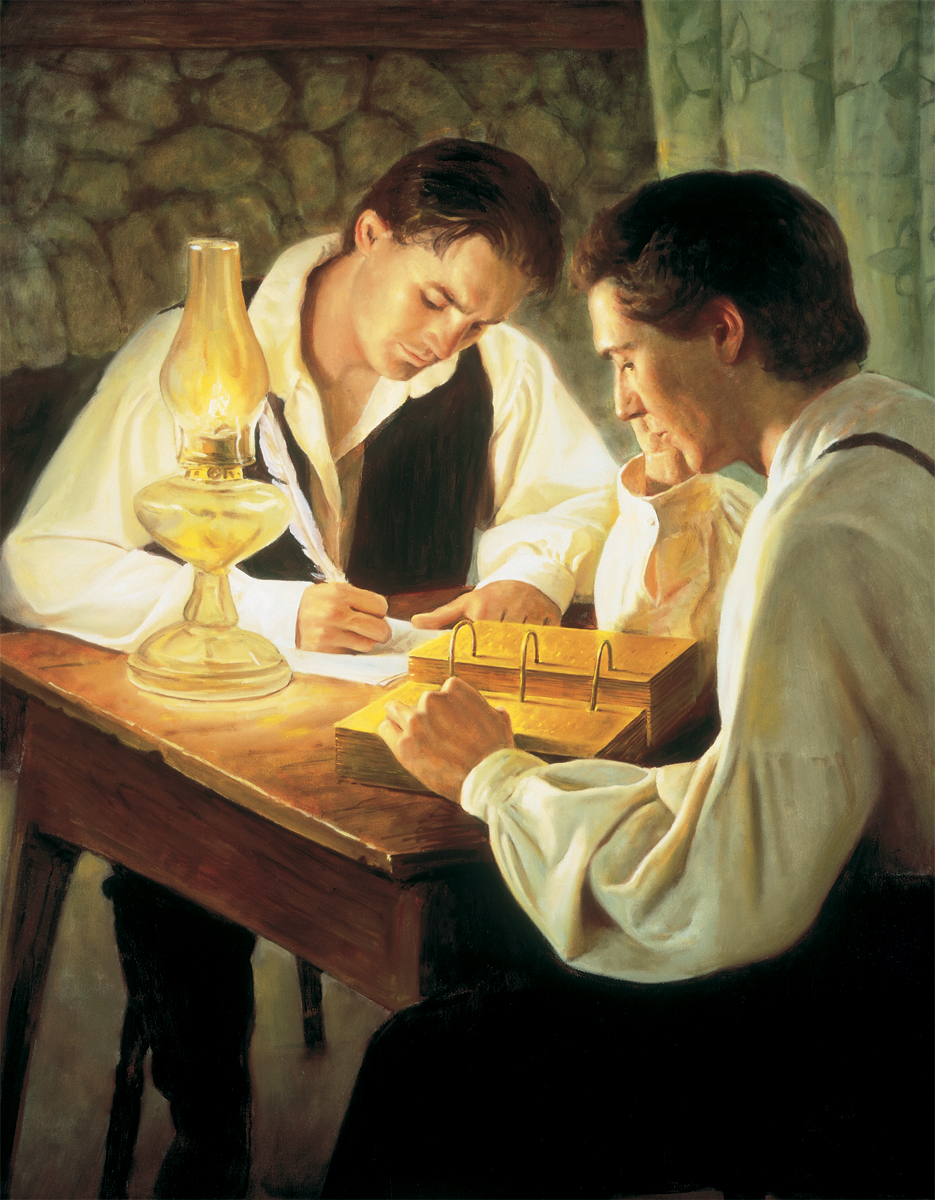
not depict Joseph Smith translating the Book of Mormon using a seer stone in
his hat (until recently—October
2015, March 2018
and June 2019)?
5. Why was all the effort that ancient
civilizations went through to produce, compile, preserve, abridge, and bury the
Book of Mormon records necessary if Joseph Smith was able to translate the Book
of Mormon without
the Golden Plates present?
6. Why did several of Joseph Smith’s early
revelations lead his friends and followers into endeavors that can appear not
to have achieved their stated objectives? [selling
the copyright to the Book of Mormon; Zion’s
Camp; the
search for treasure in Salem; the
United Order; the
command to build a temple in Missouri]
7. Can all of Joseph Smith’s trouble with law
enforcement throughout
his life be dismissed as unfounded
accusations from persecutors of the Church?
8. Considering the similarities
between Freemason ceremonies and temple endowments, can it be considered suspect
that the endowment was introduced
on May 4th, 1842—less than two months after Joseph
Smith became a Master Mason?
9. Do Joseph Smith’s many titles, including
Prophet, Mayor
of Nauvoo, Lieutenant
General, Master
Mason, “chairman,
Prophet, Priest, and King over the Council and the world,” and candidate
for President of the United States, hint at anything in his character that
could lend credibility to a non-prophetic narrative that he sought power and
prestige?
10. Why did Joseph Smith teach in 1835 that the
coming of the Lord “was nigh—even
fifty-six years should wind up the scene”?
11. Can Joseph Smith’s claim
that he had translated part of the forged
Kinderhook Plates represent a legitimate challenge to his revelatory
credibility?
12. Why is Joseph Smith’s inspired translation of
the Bible so similar to Adam
Clarke’s previously published Bible commentary? [BYU
Journal of Undergraduate Research; Interview
with BYU’s Dr. Wayment, last paragraph on page 6]
13. Does Joseph Smith’s Happiness
Letter to Nancy
Rigdon, which has been frequently quoted in General Conference,
pave the way for the kind of moral relativism the Church preaches against today
(Ensign,
2014; Conference,
2014; Ensign,
2015) because of lines like “That which is wrong under one circumstance,
may be and often is, right under another”?
14. Why do Church videos tend to depict Joseph Smith
as unarmed when he was
martyred—even though it’s historically
documented that he was provided with a gun and that he defended himself by
shooting three of his attackers?
15. Why did Neil L. Andersen advise us to “give
Brother Joseph a break” instead of providing inspired, apostolic
explanations for some of the controversial events in the prophet’s life?
Scripture
The Book of Mormon
16. Can reasonable questions about the credibility
of the Testimony of the Eight Witnesses arise considering their statement bears
the eight names written
in the same handwriting (instead of the men’s signatures) and considering
all witnesses were members of either the Whitmer family (Hiram Page was married
to a Whitmer) or the Smith family?
17. Is the power of the Book of Mormon witnesses in
any way diminished by the fact that James Strang was also
able to produce multiple
witnesses for his Voree Plates?
18. Is it strange that the Angel Moroni reclaimed
the Golden Plates that bear unique ancient symbols but did not reclaim the
ordinary-looking seer stone used to translate them—only for it to remain unused
until the Church publicized
its existence in 2015?
19. Although some things in the Book of Mormon once
thought to be anachronistic (such as cement and barley) have been demonstrated not
to be anachronistic, do those discoveries have any effect on whether remaining
anachronisms will be overturned (such as horses, chariots, steel, elephants,
silk, honey bees, and wheat)?
20. If, as President
Ezra Taft Benson taught, the Book of Mormon was written for our day with an
inspired collection of records, stories, and speeches that would be most
relevant to us, why does so much of 2 Nephi quote what’s already available in
Isaiah, why do large sections of Alma go into such detail on secular
warfare, and why does Ether include so many summaries of the lineage of
Jaredite kings?
21. Why do so many passages from the Book of Mormon
and the King James Bible match up word-for-word even though one was translated
from Hebrew to Reformed Egyptian to 19th-century English and the
other was translated from several languages (Hebrew, Aramaic, and Greek) into
17th-century English?
22. If the term “Christ” comes from the
Greek “christos” used to translate Jesus’s Hebrew title in early Biblical
translations (anglicized in the present day as “Messiah,” meaning “anointed
one” in the original Hebrew), why would the translated Book of Mormon not simply use the English
title “Messiah” instead of a Greek word that wouldn’t have been spoken in
ancient America?
23. If the Hill Cumorah where Moroni buried the
golden plates is the same location as the final battles of the Nephite
civilization and the Jaredite civilization (an
idea put forth by Bruce R. McConkie), should there be millions of weapons
and other ancient artifacts littering the area surrounding Cumorah?
24. If the Book of Mormon contains “the
fulness of the gospel,” what could be the reason that it does not discuss
eternal marriage, baptism for the dead, temple endowments, the age of
accountability, the three degrees of glory, eternal progression, the Aaronic
and Melchizedek Priesthoods, or the offices of bishop, patriarch, stake
president, and seventy?
25. If 1
Nephi 1:20, which is often called the thesis statement of the Book of
Mormon (Deseret
News; BYU
professor Daniel C. Peterson; The
Church News; some
LDS blogger; some
other LDS blogger) indicates that the “tender mercies” of God will make his
faithful followers “mighty even unto the power of deliverance,” is that thesis
statement undermined by the fact that the Book of Mormon outlines the splitting
of a family into rival factions, chronicles a thousand years of repeated wars
and conflicts, and ends with the righteous becoming extinct and the wicked
inheriting the promised land?
26. Why did Nephi claim that “the Lord giveth no
commandment unto the children of men save he shall prepare a way” even
though we know that the first two commandments God ever gave in the Garden of
Eden were mutually
exclusive (multiply
and replenish the earth but don’t eat the fruit)?
27. Could there have been other possible divine solutions for
Nephi’s inability to get the brass plates from Laban other than an instruction to break
one of the Ten Commandments?
28. Why did God command
Nephi to kill Laban if, according to Ether
8:19, “neither doth [the Lord] will that man should shed blood, but in all
things hath forbidden it, from the beginning of man”?
29. Are the similarities between the vision of the
Tree of Life in 1 Nephi and a
dream Joseph Smith, Sr. had in 1811 a possible indication that Joseph Smith
drew upon his family’s experiences while bringing forth the Book of Mormon?
30. Is it odd that the prophecies of history in 1
Nephi 13 outline Jesus’s appearance after His death, the formation of a
great and abominable church, the arrival of Christopher Columbus, and the
coming forth of the Book of Mormon, but nothing more recent than Joseph Smith’s
lifetime?
31. Why does Nephi say in 2
Nephi 5:15 that gold, silver, and precious ores were in “great abundance”
but explain in verse 16 that he didn’t build his temple of so many precious
things because “they were not to be found upon the land”?
32. In the Allegory of the Olive Tree, why does
Jesus want to cut
down the vineyard and burn it and why is it the servant who has to talk him
out of it?
33. Is King Benjamin’s statement that “the
natural man is an enemy to God, and has been from the fall of Adam,” a
reference to the kind of punishment for Adam’s transgression that the second
Article of Faith states we should not receive?
34. Does it say anything about God’s capacity for compassion
that he allows his prophet to teach principles that can appear to belittle His
children, such as “the
natural man is an enemy to God” and that no matter how much we give to Him
we will still be “unprofitable
servants”?
35. How are the relationships between God the
Father and Jesus Christ described in 2 Nephi 11:7, Mosiah 15:1-4, Alma 11:38-40, 3 Nephi 11, Ether 3:14, and Ether 4:12
distinguished from the concept of the Trinity?
36. How did Alma the Elder gain the authority to baptize
without the laying on of hands and why did it require a long-dead holder of the
priesthood to appear in the modern dispensation to restore that authority?
37. If God knows the desires of our hearts, why did
he need the blood of the righteous people of Ammonihah to stand as a witness
against the city’s chief judge?
38. How does the teaching that God would not save
the Ammonihahites so that “blood
of the innocent shall stand as a witness against” the perpetrators align
with the story of the Stripling Warriors, in which Helaman declares that “whosoever
did not doubt...should be preserved by [God's] marvelous power”?
39. Is it concerning that there is no mention of a
warning shot or any attempt at diplomacy before Ammon began killing and maiming
thieves in defense of
King Lamoni’s sheep?
40. In his capacity as a missionary, was it right
for Ammon to threaten the
life of Lamoni’s father, even as a negotiating tactic?
41. Why does Alma
chapter 41, despite having a convenient context in which to discuss the
degrees of glory, imply that the afterlife has only two destinations?
42. If God “cannot
look upon sin with the least degree of allowance,” why did he destroy the
sinful Nephites but not destroy the
sinful Lamanites?
43. When Zerahemnah surrendered his weapons to
Captain Moroni but admitted that he couldn’t promise never to fight the
Nephites again, would Christ have made the same decision that Moroni did to demand
that Zerahemnah choose between death and swearing a dishonest oath?
44. Was it morally justified or consistent with the cause
of freedom when Moroni executed
Amalickiahite prisoners who would not vow to support free government?
45. Are there any problems—morally or
politically—with Moroni
threatening to execute citizens of his own nation who did not wish to join
his army?
47. Was it a righteous decision for Moroni to threaten
to use Nephite children as soldiers if Ammoron didn’t meet his demands?
48. Were any positive or Christlike attributes
exhibited by Captain Moroni when he to threatened
to kill the leader of his own government?
49. Other than his strong belief in the gospel, what
else about Moroni’s behavior supports the claim
made in Alma 48:17 that “if all men had been, and were, and ever would be,
like unto Moroni…the devil would never have power over the hearts of the
children of men”?
50. Could it be evidence of human authorship rather
than divine translation that Alma
chapter 56, which contains a letter written by Helaman, refers to Helaman
in the first person until verse 52, which twice refers to Helaman by name in
the third person?
51. What are the differences between the secret
combinations with secret signs condemned
in the Book of Mormon and the modern temple ceremonies’ signs and tokens
that the participants are instructed not to discuss publicly?
53. When is the last time someone was converted to
the gospel with such intensity that it involved a loss of consciousness or a
massive muscle failure, like what happened repeatedly in the Book of
Mormon? [Alma
the Younger; King
Lamoni; Lamoni’s
entire household; Lamoni’s
father; the
five men who confirmed Nephi’s prophecy that the chief judge had been murdered;
Nephites
witnessing the signs of Christ’s birth]
54. Does the public execution of an enemy with a
joyful prayer that God will punish other enemies in the same way demonstrate
sufficient dedication to the cause of peace or sufficient respect for human
life? [3
Nephi 4:28-31]
55. How does Jesus’s use of the term “damned”
relate to the Church’s current teachings about the possible destinations of
souls in the postmortal existence?
56. Did the addition of the endowment and the
sealing ordinance constitute declaring more than the baptism-centric
doctrine Jesus taught in 3
Nephi 11:38-40, an act He said “cometh of evil”?
57. Why did Jesus allow the disciples to pray to him
in 3
Nephi 19:18 if he told them in 3
Nephi 18:19 that they should pray to the Father?
58. When Jesus quoted Malachi 4 in 3
Nephi 25, why did he advise the Nephites to remember the Law of Moses if His
atonement had already made that law obsolete?
59. Why are the promises made to Nephite disciples
in 3
Nephi 28 to “speedily come unto thee in thy kingdom” or to “never taste of
death” not available to the rest of us in the same way by a simple, faithful
request?
60. Is there any contradiction in the land of Desolation
first being located in the northern Nephite territory near Bountiful (Alma
22:29-30, Alma
50:33-34, and Alma
63:5) and later being located in the southern Nephite territory near the
Lamanite lands (Mormon
3:5-6 and Mormon
4)?
62. In its final
battle that cost all but 24 lives out of a force of 230,000, is it strange
that Mormon’s army was able to sustain a higher percentage of casualties than Pickett’s Charge, the Battle of the
Thermopylae, or the Charge of
the Light Brigade, as well as numeric
losses greater than the Battle of Antietam,
the Battle of the
Bulge, or the combined deaths from both
atomic bombs?
63. If God “is
a God of miracles,” why do prophets and apostles no longer have current
stories of miraculous mass healings (ten
lepers; malaria
victims in Nauvoo) or miraculous manipulation of natural forces (walking
on water; parting
the Red Sea; gulls
in the Salt Lake Valley) or angelic visitations (Nephi,
Laman, and Lemuel; Nephi
again; Alma
the Younger; restoration
of the Aaronic Priesthood; Joseph
Smith and Oliver Cowdery in the Kirtland Temple) or raising the dead (Lazarus
raised by Jesus; Timothy
raised by Nephi) or other miraculous displays of power (the
brother of Jared moving the mountain of Zerin; Nephi
and Lehi protected in prison)?
64. How were the Jaredites, at best a Bronze Age
civilization, able to construct watertight,
submersible ocean-faring vessels?
65. How were the Jaredites able to fit enough food
and fresh water in their eight
tree-length
barges for all the voyagers and all their livestock to survive the 344-day ocean journey?
66. Why were cureloms
and cumoms—unlike
other animals in the Book of Mormon such as horses, sheep, and elephants—not
translated into English words?
68. Ether
12:6 teaches that “ye receive no witness until after the trial of your
faith,” but wasn’t a witness without a trial of faith given to Laman
and Lemuel, Alma
and the sons of Mosiah, Saul
of Tarsus, Korihor,
King
Lamoni’s household, and the
Lamanites who stormed the jail to kill Nephi and Lehi?
69. If two
million Jaredites died in the final battles of their civilization and Shiz
and Coriantumr had armies of approximately one million soldiers each, doesn’t
that mean the probability of the last two people alive being specifically Shiz
and Coriantumr would be roughly one in one trillion?
70. According to Moroni, if the Church is true and
has 15 million believing members, should angels still regularly
minister unto men?
71. If it’s awful
wickedness to say that God will save a baptized child and damn an
unbaptized child, but it’s not awful wickedness to say the same about adults,
doesn’t that mean that God is a partial God and a respecter of persons because
of how many children die before the age of accountability and because of how
many adults die without an opportunity for baptism?
72. In Moroni
chapter 9, when the Lamanites “deprived [their prisoners] of that which is
most dear and precious above all other things, which is chastity and virtue,”
and in the next verse those prisoners are tortured and killed, does that imply
that woman’s virginity is more precious than her life?
The Doctrine and Covenants
73. Why did the Church rescind doctrine from the
Doctrine and Covenants by removing the Lectures on Faith in 1921 through
a committee process instead of by prophetic revelation or by a churchwide
vote?
74. Why was a restoration of the priesthood through John
the Baptist and through Peter,
James, and John necessary if the Three
Nephites were still alive and still held the priesthood given to them by
Christ in 3
Nephi 18?
75. Why was a revelation from 1830 that was first
published in the 1833
Book of Commandments expanded in the 1835
Doctrine and Covenants to include a section about heavenly visitors who are
not mentioned in the original revelation? [This is currently D&C
section 27]
76. Why are Elijah and Elias treated as separate
beings in Doctrine
and Covenants 27 and during the visitations
in the Kirtland Temple if they were the same Biblical person? [Elias is the latinized form of the
name Elijah and Paul quotes Elias in Romans
11:2-3 with Elijah’s words from 1
Kings 19:14]
77. Why is the Terrestrial Kingdom compared to the glory
of the moon instead of to the glory of the Earth?
78. How can the statement in Doctrine
and Covenants 77 that the Earth will only exist for a total of seven
thousand years be reconciled with the scientific consensus that the Earth is
billions of years old and that homo sapiens has existed for hundreds of
thousands of years?
79. When Joseph Smith prophesied
of the American Civil War in Doctrine and Covenants 87, why do some of his
predictions appear not to have come to pass, such as Britain joining the war,
other nations being pulled in, slaves revolting, Native American remnants
attacking the Gentiles, various natural disasters, and the end of all nations?
80. Why are we accountable for some things that are
not in the Word of
Wisdom (coffee and tea) but not accountable for something that is
(eating meat only in times of winter, cold, or famine)?
81. Doesn’t the devil know that he does not have a
body, therefore making it easy for him to pose as "the spirit of a just man made perfect" by declining to shake hands when Doctrine
and Covenants section 129’s method of detecting a false angelic messenger
is applied?
82. Could the teaching that children
who die before the age of eight are eligible for the Celestial Kingdom
create any inequities in the Plan of Salvation between those who were sent here
briefly to receive a body and those of us who were sent here to prove our
worthiness over a lifetime that extends long past the age of accountability?
83. Could the fact that only
3 sections and 2 official declarations have been added to the Doctrine and
Covenants since Joseph Smith’s death indicate that direct prophetic revelation
has waned significantly since 1844?
The Pearl of Great Price
84. Why has academic Egyptological study delineated starkly
different interpretations of the Book of Abraham facsimiles than the
interpretations provided by Joseph Smith?
85.
86. If God’s work
and glory is to bring to pass the immortality and eternal life of man, why
did he condemn a third of his children at the outset of his plan, allow his
gospel to be absent from the earth for almost two thousand years, and then
establish a church that, in the last days, still only represents approximately
two tenths of one percent of the planet?
87. If an important distinction between Jesus’s
and Lucifer’s plans was that Jesus wanted to deflect all the glory to God,
why is the Church named after Jesus instead of God, why do we call Jesus our
Savior, and why do we celebrate Jesus’s birth and resurrection without any
holidays for God the Father?
88. Why does modern astronomy not align with the explanation
of Facsimile 2 Figure 5 in the Book of Abraham, which states that certain
stars receive their light and power from the revolutions of Kolob?
89. If a big part of Joseph Smith’s story was a need
for clear answers to the numerous
conflicting denominational interpretations of the Bible, why is there so
much variety
in the interpretations of the Book of Mormon?
90. In Joseph
Smith—History, why does the prophet state in verse 10 that “I often said to
myself…are [the churches] all wrong together,” but state in verse 18 when he
was in the Sacred Grove that “at this time it had never entered into my heart that
all were wrong”?
91. Why did God need to prepare the Urim and Thummim
for the purpose of translating the golden plates (Joseph
Smith—History 1:35) if, according to the Church
website’s essay on seer stones, Joseph could use the Urim and Thummim and
his own previously found seer stone “interchangeably”?
The Plan of Salvation
92. How will proxy temple ordinances be performed
for the countless people for whom there is no genealogical record whatsoever?
93. How does the Second
Anointing align
with the purpose of mortal life being to test us based on our faith and our
actions?
94. If God is such a strong proponent of free
agency, why did he condemn Lucifer’s followers for all eternity with no hope of
redemption even though they’d exercised their free agency on exactly one issue?
95. What sins have you committed for which eternal
separation from God would be a fair punishment (if you had received no
ordinances) and what sins could you commit that would cause loving
mortal parents to punish you with permanent separation?
96. Should we need to meet an age requirement, a
worthiness requirement, and an ordinance requirement to be eligible for full
communication from our Heavenly Father—and what requirements would loving
mortal parents impose for their children to be eligible to communicate with
them?
97. If resurrection will restore our physical bodies
so that not
one hair from our heads shall be lost, and if the Proclamation on the
Family declares that “gender is an essential characteristic of individual
premortal, mortal, and eternal identity and purpose,” why would apostle Joseph
Fielding Smith teach that in the Terrestrial and Telestial Kingdoms “the power
of procreation will be removed” and that “men
and women will, in these kingdoms, be…neither man nor woman”?
98. Would a perfected being have emotionally evolved
beyond the need to be worshipped by His children?
99. If there must be an
opposition in all things and Adam would not have fallen without
someone to tempt him to eat the fruit, could this mean that God
intentionally created Lucifer as an evil being in order to make the Plan of
Salvation possible?
100. Doesn’t Jesus’s role as an advocate with the
Father (Doctrine
& Covenants 45:3-5; 1
John 2:1) make him more merciful than God?
101. If God’s love is not unconditional [Elder
Christofferson; Elder
Nelson, in which he also quotes President Joseph F. Smith expressing a
similar sentiment], why are we held to a higher standard of love [President
Kimball instructing us to love our families unconditionally] and why does
Jesus have unconditional love [Elder
Nelson] if God the Father does not?
102. Can the Plan of Salvation be seen as inefficient
when it has a lot of elements that can be interpreted as post hoc corrections
for the weaknesses of other elements?
[Establishing a church compensates for the veil of forgetfulness at
birth; Missionary work compensates for limited access to ordinances; Proxy
ordinances compensate for the limits of missionary work; Genealogy compensates
for limits of proxy ordinances; Temple Sealings compensate for separation in
the afterlife]
103. Because Joseph Smith was told in revelation that
he would see the coming of the Son of Man if he lived to the age of 85 (Doctrine
and Covenants 130:14-15), does that mean that God’s purposes can be delayed
by more than a century due to the loss of one individual whose death the
omniscient God would have foreseen?
The Modern Church
Organization and Procedure
104. If “we
believe in the same organization that existed in the primitive church,”
isn’t it odd that there are 15 apostles in the current dispensation but only 12
were established by Jesus during His mortal ministry and only 12 were
established during His post-mortal visit to the Nephites?
105. Why does a church that is so proud of its
worldwide membership draw disproportionately
from its western US population for its highest levels of leadership? [US
membership of 6,681,829 and worldwide
membership of 16,313,735 shows 59% of members live outside the US]
106. If no one should be ordained to any office in
the Church without a vote of the membership (Doctrine
and Covenants 20:65), why have so
many prophets been ordained before their first General Conference? [Monson’s announcement; Nelson’s announcement]
107. Why is there no scriptural revelation for the
order of prophetic succession?
108. Considering how many Book of Mormon prophets and
scriptural authors were from the
same lineage, does that mean that Joseph Smith III might
have had a
valid claim to the Presidency of the Church?
109. Why are mystical objects—such as the Liahona used
by Lehi’s family, the translation tools once possessed by King Mosiah and the Jaredites, or the seer stone used by
Joseph Smith—no longer utilized as prophetic resources?
110. Does Elder Bednar’s explanation for why “we
can expect the President and other senior leaders of the Church will be older
and spiritually seasoned men” allow for God’s method of preparing younger
prophets like Jeremiah,
Samuel,
Mormon,
Joseph
Smith, and Brigham Young for the work of the gospel?
111. Would the present-day Church ever call an
apostle who was previously an outspoken critic (like Saul of Tarsus or Alma the
Younger) or who was previously excommunicated (like Orson Pratt)?
112. If Jesus was a carpenter, if Peter, Andrew,
James, and John were fishermen, if Joseph Smith was a farm boy, and if the
symbolic humility of these vocations is so important, shouldn’t we expect to
find a few former factory workers and janitors and short order cooks among
today’s apostles? [Nelson was a surgeon;
Oaks was a jurist; Eyring was a professor;
Ballard was a
businessman; Holland
was an education administrator; Uchtdorf was a senior
VP for Lufthansa; Bednar
was a professor; Cook
was a lawyer; Christofferson
was a lawyer; Andersen
was a businessman; Rasband
was the COO of Huntsman Chemical; Stevenson was the COO
for ICON Health & Fitness; Renlund was a cardiologist;
Gong was in the US State
Department; Soares
was a corporate auditor]
113. If the Book of Mormon is true, what assurances
do we have that the Church of Jesus Christ of Latter-day Saints is the correct
continuation of that restored truth—as opposed to the Strangites, the Bickertonites, the Temple Lot church, the Snufferites,
the Community of Christ, the Kingston Group,
the Fundamentalist
LDS church, or any
other church that traces its roots back to Joseph Smith’s restoration of
the gospel and his divine translation of the Book of Mormon?
114. Although it’s understandable that a religious
organization inspired of God can make mistakes through its imperfect leaders,
is there a level of imperfection or an accumulation of individual imperfections
that would preclude the possibility of that organization being inspired of God?
Finances
115. Is the practice of tithing members’
interest or surplus as outlined in Doctrine
and Covenants 119 better reflected by the current tithing policy of the
Church of Jesus Christ of Latter-day Saints or by the current tithing
policy of the Community of Christ?
116. Why would a loving God expect us to pay our
tithing before we make sure our families are provided for, as taught by Elder
Lynn G. Robbins in the April
2005 General Conference, as written in the December
2012 Ensign, and as taught by Elder Valeri
V. Cordón
in the April
2017 General Conference?
117. Can the Church be considered to have no paid
clergy
when apostles draw
salaries, sit on the CES
Board of Directors, and sell doctrine-based
writings through the Church-owned Deseret Book?
118. When Church leaders obtain Deseret Book
publishing deals to expound on gospel topics with their apostolic celebrity
guaranteeing sales, where is the line drawn to distinguish this practice from priestcraft?
[President
Nelson; President
Oaks; President
Eyring]
119. Could Elder Durrant’s “poor
judgment” in allowing his son to create a website selling merchandise based
on Durrant’s “Ponderize” talk be interpreted as an attempt at priestcraft?
120. Could requiring a full tithe for access to the
temple be construed as the Church itself selling signs and tokens for money?
121. Regardless of any doctrinal stance on the issue
at stake, should it be okay for a religious institution to contribute
almost $200,000 to influence the outcome of a state’s political referendum?
122. What non-financial gospel purposes are served by
the Church’s housing
complexes,
its shopping malls, its private
hunting preserve, its cattle ranch, its insurance
company, and its other large
real estate holdings?
123. What is the ratio between the number of temples
the Church has built and the number of homeless shelters the Church has built?
124. Can anything about the Church’s priorities be
inferred from the fact that it spent approximately six times as much money to
build the City Creek Center in Salt Lake City as it spent in humanitarian cash
donations from 1985 to 2011? [an
estimated $2 billion] [$327.6
M]
125. What possible downsides beyond the effort
required to make the information available could be keeping the Church from
being transparent about its finances the way some
other churches are
and the way
the Church itself used to be?
Membership Statistics
126. Has the narrative of Church growth as the stone
cut out of the mountain without hands rolling forth to fill the whole earth [D&C
65:2, 1831; Kimball,
1976; Hinckley,
1995; Ensign,
1996; Hinckley,
2007] shifted, judging by Elder Cook’s reminder that Nephi foresaw the
Church’s “numbers
would be small because of wickedness”?
127. Is it coincidental that the Church stopped
announcing its membership statistics in General Conference after the first
five consecutive years of slowing membership growth in the entire
history of the Church?
128. Why did Elder Jeffrey R. Holland assert in April 2016 that the
Church was creating stakes in double digits each week on average when the
church only added 92 stakes during the entire year of 2016? [2015
statistical report] [2016
statistical report]
129. Is it strange that Elder Holland would predict
that the number of missionaries would hit one
hundred thousand by 2019, only for those numbers to decline
every year after the 2014 peak?
130. How well can the Church be servicing God’s goal
of spreading truth to all His children when the Church makes up approximately
two tenths of one percent of the world
population (assuming every member on record is active), when there is
currently about one full-time missionary in the world for every 115,000 people,
and when the number of convert baptisms per missionary in 2018 was less than
four?
Questions, Criticism, and Discipline
131. How many stories are told in General Conference about
an apostate or an inactive member who is happy, healthy, and successful without
eventually returning to the Church?
132. Why did Elder and Sister Renlund dismiss their
doubting friend’s actions as “church
history Whac-a-Mole” instead of acknowledging the legitimacy of his
spiritual and emotional crisis?
133. If, according to Elder Cook, “one
purpose of prophets is to help us in resolving sincere questions,” why are
none of the Gospel
Topics essays on the Church website signed by or ostensibly authored by any
of the apostles or prophets?
134. How does teaching that “when
our leaders speak, the thinking has been done” and “when
the prophet speaks the debate is over” complement our personal
responsibility to gain our own spiritual witness of what we’ve been taught?
135. Can Church leaders be considered anti-intellectual
when they make statements such as “I find it unnecessary to investigate or
rethink my beliefs,” [Henry
J. Eyring, 2018] when they refer to intellectuals as one of the three
biggest threats to the Church [Elder
Packer, 1993], and when they suggest that “research is not the answer”? [Elder
Oaks, 2019]
136. If the Church so carefully separates policy,
which can change, from doctrine,
which cannot, why does it seem to resist calls for policy changes? [policies
on race; partial
concessions to Sam Young’s call to end sexual questions in one-on-one
interviews; walking
back the November 2015 policy after more than three years of backlash]
137. Would God actually allow criticism of a leader
to diminish that leader’s capacity to perform his or her calling and is it
ethical or healthy to teach that this
is the reason why factually correct criticism of leaders is wrong?
138. Was it entirely fair for Elder Robbins to
dismiss criticism of the prophet as “guilt
trying to reassure itself,” especially considering that Elder Uchtdorf
reminded us the year before that God runs his Church through imperfect people
and that “there
have been times when members or leaders in the Church have simply made mistakes”
and considering that Elder Ballard would express
a similar sentiment to Uchtdorf’s the year after?
139. Does Elder Oaks’s assertion that the Church
does not give apologies say anything about his level of compassion or his
devotion to accountability?
140. Why did the Church summon Jeremy Runnells to a
disciplinary hearing instead of providing him with answers to the concerns he
outlined in his Letter to a CES Director?
[exchange
between Runnells and his stake president starting on page 13]
141. Why was Bill Reel told during his disciplinary
council that he could be excommunicated for calling Jeffrey R. Holland a liar in
his podcast even if Elder Holland actually was lying? [transcript,
p. 26-29, recording,
approx. 1:20:00]
142. Can the decision to excommunicate
Sam Young be construed as an indication that the Church feels a stronger
urge to protect its own authority than to protect its children from sexual
abuse?
143. Why has the Church excommunicated Fawn
Brodie, D. Michael
Quinn, Denver
Snuffer, Sam
Young, John
Dehlin, Jeremy
Runnells, Kate
Kelly, Bill
Reel, and others for publicizing criticism, but not Joseph Bishop, who has
confessed to sexual
misconduct committed while he was President of the MTC, and not Sterling van
Wagenen, who pled guilty to sexually abusing a child?
144. What, other than spiritual and emotional trauma,
can excommunication be expected to accomplish for a believer who receives it as
verdict from a disciplinary council?
145. Is it kind or Christlike for the Church to press
criminal charges against the woman who shouted “stop protecting sexual
predators” during General Conference instead of trying to understand or
address her concerns?
146. If there were a Church policy that was hurtful
and needed to be changed, what realistic options would members have to directly
alert the General Authorities of the need for a new policy?
147. If Elder Cook declared unequivocally in April
2015’s General Conference that the Church “has
never been stronger” and that “the number of members removing their names from
the records has always been very small and is significantly less in recent
years than in the past,” why have the leaders been spending so much time
discussing doubts, questions, criticism, inactivity, and apostasy? [Elder
Uchtdorf, 2013; Elder
Kacher, 2014; Elder
Ballard, 2014; Elder
Stanfill, 2015; Elder
Andersen, 2015; Elder
Ballard, 2016; Elder
Uchtdorf, 2016; Elder
Callister, 2017; BYU-Idaho
President Eyring, 2018; Elder
Cook, 2018; Elder
and Sister Renlund, 2019; Elder
Corbridge, 2019]
Statements of Modern Leaders
148. Why are revelations in Church history presented
as the words God literally spoke but anything recent that’s claimed to be
revelation is presented as the apostles’ own words based on divine inspiration?
149. Can it weaken the apostles’ claim to the power
of prophecy when Joseph Fielding Smith, as the President of the Quorum of the
Twelve Apostles, taught that “we
will never get a man into space” less than a decade before Neil Armstrong
set foot on the moon?
150. When Boyd K. Packer told a CES symposium in 1981
that “some
things that are true are not very useful,” was he advocating dishonesty by
suggesting that troubling historical data should be deemphasized or should be
omitted entirely from discussion?
151. Can it be considered blaming the victims of
trauma for Elder Scott to suggest that “the
Lord may prompt a victim to recognize a degree of responsibility for abuse”?
152. What aspect of his apostolic calling was Boyd K. Packer
fulfilling when he claimed that the three primary enemies of the Church are
feminists, homosexuals, and intellectuals?
153. When President Gordon B. Hinckley was asked
about the central and unique LDS doctrine of eternal progression in a 1997
interview with Time Magazine, was he being dishonest or evasive when he
answered: “I don’t know that we teach
it. I don’t know that we emphasize it…”?
154. If the call to avoid tattoos and piercings is
based on the teaching that the body is a temple, why did President Hinckley teach
that it’s still permissible for women to damage that temple with piercings
for one pair of earrings?
155. Was Elder Holland being dishonest when he implied that Mitt Romney would not
have sworn a temple oath—only to adjust his answer after the interviewer
demonstrated knowledge of the pre-1990
endowment ceremony?
156. How much can an organization contribute to peace
on earth and goodwill toward humankind when it teaches with so many war
metaphors? [a few recent examples to supplement hymns and scriptural references: Joy
D. Jones, Neil
L. Andersen, Bradley
D. Foster, Brian
K. Taylor]
157. Was Elder Clayton promoting a form of blind
obedience when he taught that “real
obedience accepts God’s commandments unconditionally and in advance,” or
was Elder Perry promoting a form of blind obedience when he compared
us to a team of horses and explained that “the only way for a horse to know
it is always doing the right thing is to be obedient”?
158. Does it encourage healthy relationships in
mixed-faith families when Elder Maxwell and Elder Andersen compare
apostates to Judas Iscariot?
159. Why did Elder Oaks dispel the myth of the “theology
of prosperity” if the Book of Mormon teaches this theme repeatedly? [2
Nephi 1:9-11; Jarom
1:9; Mosiah
1:7; Alma
36:1; Alma
37:13;
Alma 49:30; Alma
50:19-20; Helaman
12:1-2; 4
Nephi 1:23]
160. Considering how much the Church stresses
the importance of the family, doesn’t it seem strange or even unhealthy
that Elder Walker would praise
a pioneer’s decision to leave his pregnant wife and six children to join
the Mormon Battalion, that Elder Soares would praise
a missionary’s decision not to leave his mission after the death of his
sister, and that Elder Andersen would praise
another missionary’s decision not to leave his mission after his entire
family except for two younger brothers died in a plane crash?
161. Why would a religion that offers “ultimate
happiness [and] true peace” teach that “if
you feel a little overwhelmed, take that as a good sign”?
162. Why would President Nelson claim that using the
nickname Mormon is “a major victory for Satan” despite the fact that President
Monson used it to advertise during his administration, President
Hinckley extolled its value, and even Joseph Smith embraced it? [History of the
Church Vol 3, p. 297 “Truth is ‘Mormonism.’ God is the author of it.”]
163. With all the problems in the world, why would
God choose to have His prophet reveal that the nickname of His church is “a
major victory for Satan” instead of having him denounce something that is
causing widespread suffering among His children?
164. Is the hand that a person uses to take the
Sacrament really so crucial to the efficacy of the ordinance that it required
Elder Oaks to publicly correct deacons who had taken it with their left hands?
165. Do Church leaders tacitly admit that, despite
scriptural precedents and the restoration of Priesthood power, there is a
present-day lack of public, visible, miraculous healings? [Elder
Hallstrom cited being a child of God, having a body in His image, and the
potential for eternal life as examples of miracles; Elder
Bednar taught that we should have the faith not to be healed; Elder
Eyring told a story of a friend with cancer whose miracle was not to be
healed but to have a moment of lucidity with her family before she passed]
166. Are some of the Church’s efforts to downplay the
possibility of scriptural-style angelic visitations (Elder Oaks in a multi-stake
fireside; Elder
Holland in General Conference) similar to what
Joseph Smith was told during the early days of the Restoration?
Social Issues
Gender
167. When Elder Oaks taught in a General Conference
Priesthood session that “women
and men are equal, with different responsibilities,” is it likely that,
after his long career in law, he would not have recognized while writing his
talk how similar his phrasing was to “separate but equal”?
168. Does the teaching that God will call a man
through the veil by his temple name and then the man will call his wife through
the veil by hers mean that, as Brigham Young is reported to have said, “woman
will never get back [into God’s presence], unless she follows the man
back”? [Quoted
in the Introduction to William Clayton’s journals under the section titled
“The Nauvoo Temple, 1845-1846”]
169. Do teachings such as Elder Oaks’s claim that
immodestly dressed women are “becoming
pornography” and Elder Callister’s claim that when a woman’s clothing is “too
low or too high or too tight, it may prompt improper thoughts, even in the mind
of a young man who is striving to be pure” shift responsibility away from
men and onto women when it comes to controlling one’s thoughts and actions?
170. Can the Church be said to treat women with the
same respect it treats men when it has taught that “it was never intended by
the Lord that married women should compete with men in employment” [President
Benson quoting President Kimball], when an apostle advises women seeking husbands
not to “wander around
looking like men…put on a little lipstick now and then,” and the when the
prophet tells men that their wives are their “most
precious possessions”?
171. Is it fair to say that women have a strong voice
in the Church when only 9 of the 130 General
Authority positions can be filled by women?
Race
172. Why would a God who created humanity and knows
our natures have chosen to use skin color as a
way to distinguish between the wicked people and His chosen people?
173. Why does the Book
of Mormon teach that dark skin is unenticing and why does God seem to
believe that dark skin would make someone loathsome?
174. Why does Mormon call the Native Americans “dark,
filthy, and loathsome” and wicked beyond precedent while not mentioning any
of the loathsomeness among the Gentiles who would later manipulate them, steal
from them, and murder them?
175. What explanations do we have for the policy that kept black members from
the blessings of the priesthood and the blessings of the temple that can
demonstrate that the policy was moral?
176. Why have so many racially charged and unkind
things been proclaimed by past prophets and apostles, such as Brigham Young
teaching that interracial
relationships are punishable by death, Mark E. Peterson claiming that black
people could enter the Celestial Kingdom as servants, and Bruce R. McConkie
writing in Mormon Doctrine that “negroes are not equal with other races”
due to a “lack
of spiritual valiance” in the premortal existence?
177. Regardless of the ban in place to prevent black
members from receiving temple ordinances, was it still racially problematic for
the Church to allow Jane
Manning James, a black woman, to be eternally sealed
to Joseph Smith specifically as a servant?
178. Why was a hoax
website the closest the Church has come to issuing an official, explicit
apology for the Church’s
past policies regarding race?
Sexual Identity
179. Is there any data to support Elder
Spencer W. Kimball’s teachings in The Miracle of Forgiveness that
masturbation can lead to homosexuality and that homosexuality can lead to bestiality?
181. Was the November
2015 policy, which excluded children of gay married couples from receiving
the saving ordinance of baptism until they children reach age 18 and acquire
First Presidency approval, in keeping with the second Article of Faith?
182. Why would the Church add a
policy in its handbook that excluded gay couples and their children only to
rescind
it less than four years later?
183. If, as Elder Nelson stated, the 2015 additions
to the Church’s handbook in response to the legalization of same-sex marriage
were revealed as part of a “prophetic
process,” why was the “the mind of the Lord and the will of the Lord” on
this matter so short-lived?
184. Would Jesus, who was criticized for being friendly
with sinners, endorse Elder Oaks’s advice that “in
most circumstances,” parents should ask children in homosexual
relationships not to bring their partners to family events, and would He
support Elder Christofferson's admission that allegiance to the Savior means
that “relationships
may be interrupted” between family members who have made different choices?
185. Does it display an inordinate focus on
homosexuality that, during a presentation about the Church’s information
security, Elder Ballard and Elder Oaks seem less concerned about security and
more concerned about whether an information leaker in the news was “confirmed homosexual?”
[timestamp
approx. 5:00]
186. When prophets and apostles have taught
marginalizing things like “there
are no homosexual members of the Church,” lightheartedly condoned violence
against gay men [starting
at 10:39] in a speech that was published as a pamphlet
for adolescent boys, and declared that confusing gender and distorting marriage
are two notable methods by which Satan “seeks to destroy God’s
work,” is it possible that the Church bears some of the
responsibility for Utah’s high
teen suicide rates?
Polygamy
187. If the revelation on polygamy was given in 1843
because God was answering Joseph Smith’s questions about “the
principle and doctrine of…having many wives and concubines,” why had Joseph already taken approximately
28 additional wives before God revealed the “conditions” of this “new and
everlasting covenant” to him?
188. Why did Joseph Smith marry
dozens of women—including girls as young as 14, mother and daughter pairs,
and women who were already married to active Church members—and then permit a denial
of the practice of polygamy to be published in The Times and Seasons, a
newspaper for which he served
as editor (with names of purported certifiers attached to the article,
including Eliza
R. Snow, who’d married the prophet less than five months prior, and Newel K.
Whitney, who’d given the prophet consent to marry his daughter Sarah less than
four months prior)?
189. Why did Joseph Smith not follow the procedures
for polygamy laid out in Doctrine
and Covenants 132 (including
obtaining consent from the first wife and only marrying virgins)?
190. Can it paint the origins of polygamy in a different
light for Oliver Cowdery to have referred to the relationship between Joseph
Smith and his first polygamous wife, the sixteen-year-old Fanny Alger, as “a
dirty, nasty, filthy affair”?
191. Why did Joseph Smith say in 1844, when he
already had dozens of wives, “What a thing it
is for a man to be accused of committing adultery, and having seven wives, when
I can only find one”?
192. Was God compromising Joseph Smith’s free agency
when He sent an angel
with a drawn sword to threaten him with destruction if he did not keep the
commandment of polygamy?
193. What are the most likely reasons for Joseph
Smith to have married young women who lived in his home? [Sarah
and Maria Lawrence; Emily
and Eliza Partridge; Fanny
Alger]
194. If Doctrine and Covenants 132 indicates that the
purpose of polygamy is to multiply
and replenish the Earth, why is there so much debate over whether
Joseph Smith had sex with his plural wives and why is it so difficult to
determine if Joseph had any children by them?
195. If Jacob
2:23-30 implies that polygamy is an abomination unless the Lord commands it
to raise up seed, why was Joseph Smith married
to women who already had husbands and why was at least one of his sealings
conducted while the woman was pregnant
with another husband’s child?
196. Is there an inequity inherent in Doctrine and
Covenants 132 providing means for men to take additional wives without
committing adultery but specifically
stating that women who take additional husbands commit adultery and risk
destruction?
197. Why did God make such extreme threats and
extravagant promises when it came to polygamy?
[Emma Smith was told “she
shall be destroyed” if she didn’t accept polygamy; Zina Diantha Huntington
Jacobs was told that an
angel with a drawn sword threatened Joseph Smith that if he did not
establish the principal of polygamy he would be stripped of his priesthood and
killed; Helen Mar Kimball was told if she married Joseph Smith, “it
will ensure your eternal salvation and exaltation and that of your father’s
household and all of your kindred”; Joseph Kingsbury was told he and his
deceased wife will be “crowned
& enthroned togeather in the Celestial Kingdom of God” for his
participation as a public husband for Joseph’s wife Sarah Ann Whitney]
198. Why was a section declaring unequivocally
monogamous beliefs included in the Doctrine
and Covenants in 1835, allowed to remain as scripture during the polygamous
eras of Joseph Smith and Brigham Young, and finally
removed in 1876, only for an official declaration affirming monogamy to be
issued 14 years later?
199. Why did the Church allow
polygamist marriages in non-US territories (and even a few in Utah) even
after the official
declaration of 1890 unequivocally stated—without qualifying by locale or by
national law—that polygamy was being neither taught nor permitted?
200. Why did President Hinckley say on Larry King
Live that polygamy is not doctrinal when it’s still canonized
in the Doctrine and Covenants, when it was taught
as a requirement for exaltation by Brigham Young, and when two of the First
Presidency are currently sealed to multiple women, making them polygamists in
the afterlife?
201. Why do Church-produced films like Joseph
Smith: The Prophet of the Restoration implicitly depict the prophet as
being monogamous, especially when accusations of polygamy played a central role
in the events leading
to Joseph Smith’s murder?
Miscellanea
202. Is it possible that the Church gave its own documentary about
itself the same name as a previously
released unflattering documentary as part of a strategy to prevent people
from finding negative representations of the Church by giving the new film a
higher public profile and a higher search engine profile?
203. How would Jesus, who advised
us to give not our alms to be seen of men, feel about the branded
yellow shirts the Church has its volunteers wear during disaster relief
efforts?
204. Why is the symbol on the top of the temples
Moroni, who is not an object of worship, instead of the Savior?
205. As far as the efficacy of invoking God’s healing
power is concerned, should there be any difference between a prayer of an
ailing member, a priesthood blessing pronounced on that ailing member, and that
ailing member’s name being added to the temple prayer roll?
206. If we have already prayed in faith with a
request for divine aid, why should going without food for a period of time make
our prayers more actionable in God’s eyes—especially considering the many
scriptures that discuss receiving answers to prayers and make no mention of
fasting? [1
Nephi 15:11; Moroni
10:4; Doctrine
and Covenants 8:1; Doctrine
and Covenants 29:6; Matthew
21:22; James
1:5-6]
207. Why is money discussed in the temple endowment
narrative if there should have been no concept of trade, commerce, or currency
when Adam and Eve were the only two humans in existence?
208. Why don’t temple preparation classes describe
the initiatory and endowment ceremonies in detailed enough terms for people to
decide whether they’re comfortable with them before their mission calls have
been received or before the final days preceding their weddings?
209. Can it be considered a form of brainwashing to
have young children learn and perform a popular
primary song that contains the phrase “follow the prophet” fifty-four
times?
210. Why did Brigham Young teach the Church that Adam
and God the Father were the same person if this was not actually the case?
211. Why would early Church leaders including Brigham
Young have taught the concept of Blood
Atonement if it is not doctrinal?
212. Why would President Heber J. Grant use his time
in the October
1938 General Conference to share favorite quotes, poems, and hymns—and to
warn against car accidents on three separate occasions—but to make no prophetic
mention of Hitler and to deliver no prophetic warning of the Holocaust?
213. Does it threaten the credibility of the spirit
of discernment when General Authorities bought
forged historical documents from Mark Hofmann, the director of temple
endowment films pled guilty to
sexual abuse, convicted sexual abuser Michael
Jensen was found worthy to serve as a missionary, and a former MTC
President admitted
to a pattern of sexually predatory behavior?
Finding Truth
214. If faith-promoting folklore and Paul H. Dunn
stories can cause people to feel the Spirit about false things, should there be
methods of learning truth that aren’t ultimately
trumped by the divine method?
215. If the scriptures state that faith is not
a perfect knowledge, do the scriptures advise anything about having faith
in concepts against which there is plentiful evidence?
216. Why do members of other faiths claim to have
received spiritual confirmations of the truthfulness of their own scriptures
and how can we be certain that our own spiritual confirmations aren’t as misguided
as theirs?
217. Should we be expected to rely on spiritual
confirmation alone to determine truth considering that the
devil can give us false revelations?
218. If the Holy Ghost can tell
us the truth of all things, can we experience a burning in the bosom to
gain a testimony that the priesthood ban was a divinely approved policy or that
God sent an angel
with a drawn sword to instruct Joseph Smith to marry a woman fifteen years
his junior or that it was our Heavenly Father’s will to restrict
ordinance access from children of some gay parents for a short period?
219. Does the Church’s procedure for finding truth
provide any method for a truth seeker to learn if the Church is not true
or provide any advice concerning what someone should do if no spiritual
confirmation is received—other than to continue attempting to receive spiritual
confirmation?
220. Is it fair to expect people to continue making
important life decisions as though the Church is true when it can be so
difficult to find satisfactory answers to concerns that can present the
possibility that those life decisions may be based on a fraud?